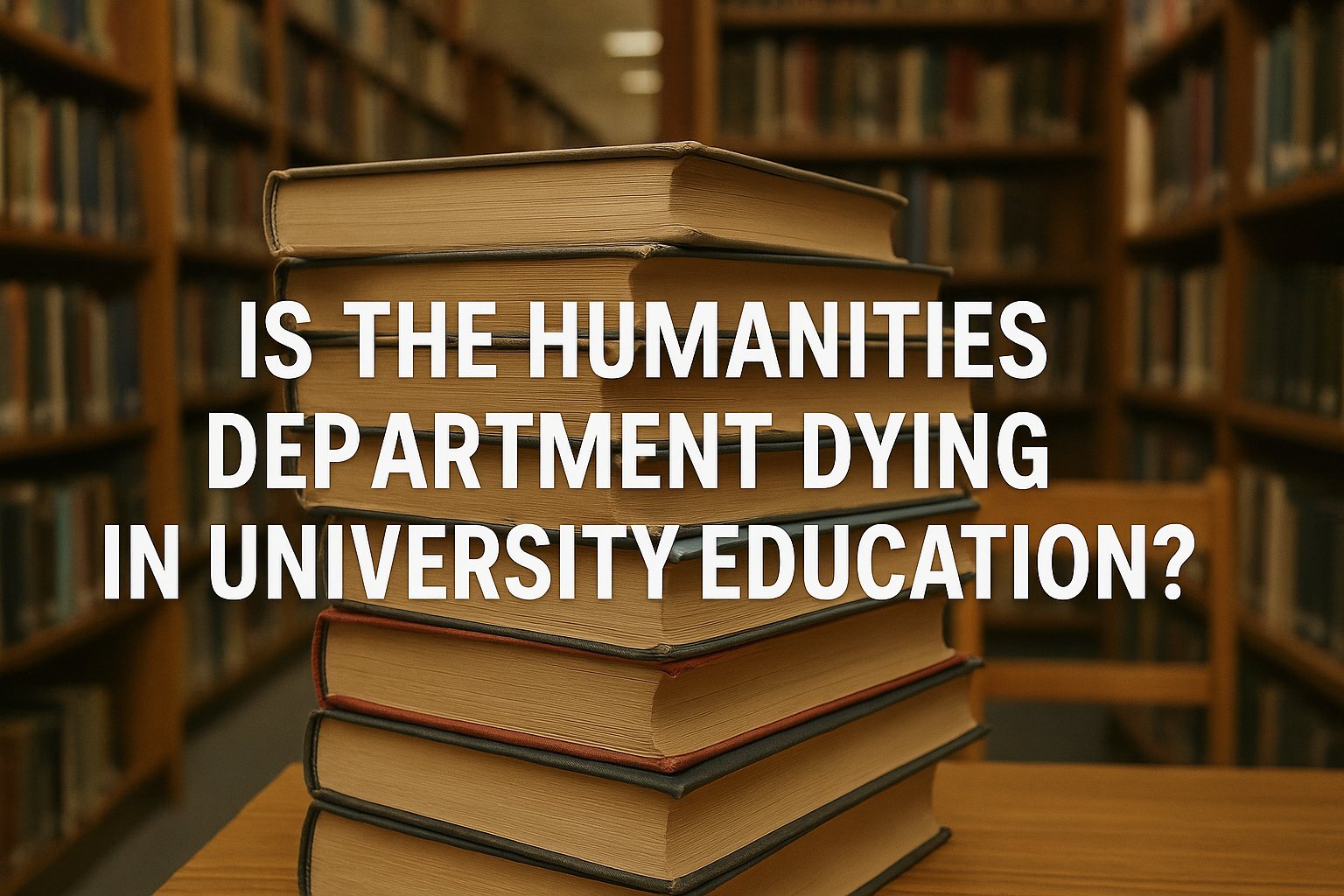
Is the Humanity Department Dying in University Education?
Introduction: A Crisis, or a Turning Point?
Headlines about collapsing enrollment, program cuts, and “useless” degrees make it sound like the humanities are on their way out. But is this really the end — or the beginning of a reinvention?
The narrative of decline has become a familiar refrain in higher education: English departments shrinking, philosophy programs shuttered, and students turning away from history in favor of computer science. On the surface, the evidence seems damning. Yet the reality is more complex than a simple story of dying departments. The humanities are indeed under pressure — but they are also adapting, evolving, and finding new relevance in unexpected ways.
This raises a central question: Are the humanities disappearing, or are they transforming to meet a changing university landscape? The answer matters not only for faculty and administrators, but for anyone who believes that a well-rounded education should do more than train students for a first job. The humanities are facing genuine challenges, but the evidence suggests they still matter — and are being reinvented in ways that could make them more valuable than ever.
The Decline Is Real: What the Data Shows
The numbers behind the humanities’ struggles are stark. In 2024, U.S. colleges awarded 165,489 bachelor’s degrees in the humanities — the smallest number since 1991 and 30% below the 2012 peak, according to the American Academy of Arts & Sciences. The humanities’ share of all undergraduate degrees has fallen from 16.8% in 2010–11 to just 12.5% in 2021–22, a decline documented by the Manhattan Institute.
Individual campuses tell a similar story. At Ohio State University, the number of English majors dropped from more than 1,000 in 2000 to about 430 in 2024 (The Lantern). Smaller humanities fields have been hit especially hard, including East Asian Languages and Comparative Studies (The Lantern). And this is not confined to a few institutions: more than 40% of history, English, and language departments reported enrollment declines between 2020 and 2023, according to a national survey from the American Academy of Arts & Sciences.
These figures paint an undeniable picture of contraction. But enrollment numbers alone tell only part of the story. The institutional response to this decline — program cuts, budget freezes, and strategic disinvestment — is where the stakes become even clearer.
Beyond Enrollment: Program Cuts, Closures, and Institutional Pressure
The pressure on humanities departments extends far beyond the classroom. Public universities in some states are being actively pushed to cut or consolidate degree programs, with humanities often among the first affected (The Guardian). These cuts are not merely symbolic; they reshape what a university is willing to offer its students.
West Virginia University eliminated multiple humanities programs in 2023, including foreign language degree programs (Inside Higher Ed). Boston University suspended doctoral admissions in parts of the humanities and social sciences (Inside Higher Ed). Missouri Western State University went even further, removing majors in history, English, and philosophy while preserving more career-linked programs (Manhattan Institute). Meanwhile, the University of North Carolina is planning to close six centers focused on humanities disciplines (The Guardian).
The common targets follow a predictable pattern: philosophy, religious studies, classical studies, and foreign languages are frequently the first to face the axe (McAllister & Quinn). These disciplines, with smaller enrollments and less obvious vocational links, are often deemed expendable when budgets tighten. Yet this approach raises a troubling question: If universities abandon the very fields that teach critical thinking and ethical reasoning, what kind of graduates will they produce?
Why Is This Happening? The Forces Reshaping Higher Education
The decline of the humanities is not an accident. It is the product of several converging forces that have reshaped the priorities of students, families, and universities.
STEM-Centric Career Pressure
Perhaps the most powerful driver is the widespread belief that STEM degrees are the only reliable path to a successful career. Universities, parents, and students increasingly favor “job-ready” degrees, and STEM fields are often seen as safer routes to employment and higher earnings (American Philosophical Association Blog). The shift is visible in course-taking patterns: enrollment in natural science and math credits has risen sharply over the last decade (JCal News). Students are not necessarily rejecting the humanities out of disinterest; many are making calculated decisions based on what they believe the job market demands.
Financial Anxiety Among Students and Families
Behind those calculations lies real financial anxiety. Many students choose majors based on debt and job security rather than interest alone (Forbes). Families often worry that humanities majors offer less obvious career payoff (McMillan Education). In an era of rising tuition and student debt, the pressure to choose a “practical” major is intense — and for many, the humanities feel like a luxury they cannot afford.
Political and Cultural Skepticism
The humanities also face a broader cultural headwind. Higher education, especially the humanities, is increasingly framed by critics as elitist or impractical (McAllister & Quinn). Public rhetoric frequently labels humanities education as “useless” in a tech-driven economy (American Philosophical Association Blog). This narrative, amplified in political debates and media commentary, shapes the expectations of students before they even step onto a campus.
The Self-Fulfilling Prophecy Problem
Perhaps most troubling is the self-fulfilling prophecy at work. When universities cut or devalue humanities programs, students notice — and enroll elsewhere. Disinvestment can reinforce the very decline institutions are trying to manage (Inside Higher Ed). By signaling that the humanities are not worth preserving, universities train the next generation to see them as irrelevant. The cuts become a cause, not just a consequence, of the humanities’ struggles.
Signs of Adaptation and Rebound
Yet for all the grim headlines, there are signs that the humanities are not merely surviving — in some places, they are thriving. The story is not one of uniform decline but of uneven transformation.
UC Berkeley saw a 121% increase in first-year students declaring arts and humanities majors in a single year (UC Berkeley Arts & Humanities). Dublin City University nearly doubled registrations in its Humanities and Social Sciences master’s programs over the past decade (UC Berkeley Arts & Humanities). Sydney University reported a 28% increase in demand for a Bachelor of Arts between 2020 and 2022 (UC Berkeley Arts & Humanities). Arizona University saw 17% humanities enrollment growth from 2017 to 2019 (UC Berkeley Arts & Humanities).
These success stories share a common thread: they involve institutions that have refused to treat the humanities as a static discipline. At Ohio State, for example, the response to declining enrollment has included launching AI-related certificates in philosophy, linguistics, and art — showing one path forward through integration (The Lantern). Rather than merely defending traditional programs, these departments are reimagining what a humanities education can be.
Why the Humanities Still Matter
The case for the humanities, however, does not rest on adaptation alone. It rests on enduring value that is arguably more important now than ever.
Employers Still Value Human Skills
Despite the push toward STEM, employers continue to prize the skills that humanities majors develop. LinkedIn’s top workplace skills include adaptability, communication, problem-solving, and research (UT Permian Basin). The U.S. Department of Labor similarly highlights oral and written communication, collaboration, critical thinking, and problem-solving as essential soft skills (UT Permian Basin). These are the capacities that a humanities education cultivates — and they are precisely the skills that remain difficult to outsource or automate.
Humanities Build Judgment, Not Just Knowledge
A humanities education does more than transmit information; it builds judgment. It strengthens ethical reasoning, tolerance for ambiguity, and the ability to analyze complex situations from multiple perspectives (John Carroll University). In an AI-driven world, where machines can generate text, images, and code with increasing fluency, critical thinking and creativity remain hard to automate (John Carroll University). The humanities teach students not just how to answer questions, but how to decide which questions are worth asking.
Career Value Over Time
The financial case against the humanities also deserves scrutiny. The earnings gap between STEM and humanities majors often narrows by mid-career (Forbes). Long-term career success depends increasingly on transferable skills — communication, leadership, ethical judgment — rather than technical specialization alone (Forbes). While a STEM degree may offer a stronger starting salary, the trajectory of a humanities education can be just as rewarding over time, particularly as careers evolve and industries change.
Humanities in the Age of AI
In an era of rapid technological change, the humanities are not obsolete — they are essential. The humanities help ensure technology remains grounded in human values (John Carroll University). The key question is not whether AI can answer faster, but whether humans can ask better questions (John Carroll University). That capacity for thoughtful questioning is precisely what the humanities cultivate — and it is what will distinguish humans from machines in the decades ahead.
The Way Forward: Innovation Over Decline
If the humanities are to thrive, they will need to change — and some universities are showing how. Innovative institutions are improving humanities enrollment by connecting these disciplines to business, engineering, medicine, and technology (Inside Higher Ed). The University of Arizona reportedly saw a 76% increase in humanities majors after adopting an interdisciplinary approach (Inside Higher Ed).
The examples are multiplying. Bowdoin College’s “Ethics in the Age of Artificial Intelligence” course shows how the humanities can speak directly to modern concerns (McAllister & Quinn). Similar partnerships are emerging at St. Anselm College, Virginia Tech, and Georgia Tech (Inside Higher Ed). The 2024 World Humanities Report argues that the humanities are especially vital in times of crisis and uncertainty (Inside Higher Ed) — and we are living in such a time.
Conclusion: The Humanities Are Changing, Not Disappearing
The evidence shows a real crisis: declining enrollment, program cuts, and skepticism toward the humanities are not figments of the imagination. But “dying” is too simple a description. Many departments are adapting, integrating, and finding new relevance in a changing landscape. As Washington Monthly argues, the humanities have a vital role to play in a technological era — provided they are willing to embrace change.
The future of the humanities likely depends on collaboration with STEM and real-world application. In an era shaped by AI, automation, and social change, critical thinking, ethics, and human understanding are more important than ever. Universities should not treat the humanities as expendable — because a well-rounded education depends on them. The question is not whether the humanities will survive, but whether universities have the courage to let them evolve.
Sources
- American Academy of Arts & Sciences — Humanities Bachelor’s Degrees
- American Academy of Arts & Sciences — The Academic Humanities Today
- American Philosophical Association Blog — The STEM-Humanities Divide and Student Defeatism
- Forbes — Myth or Fact: STEM Majors Are Inherently More Valuable Than Humanities Majors
- Inside Higher Ed — A Logical Gap Behind Attacks on the Humanities
- Inside Higher Ed — Would We Rather Humanities Be Ruined Than Changed?
- JCal News — The Decline of the Humanities Is Not Willful, It’s Just Ignorance
- John Carroll University — Why the Humanities Matter More in the Age of AI
- Manhattan Institute — Protecting the Liberal Arts and Humanities in American Higher Education
- McAllister & Quinn — Humanities for the Win
- McMillan Education — STEM vs Humanities High School Path
- The Guardian — Universities Humanities Programs
- The Lantern — The Complicated State of Humanities at Ohio State
- UC Berkeley Arts & Humanities — Increase in Humanities Majors
- UT Permian Basin — The Impact of a Humanities Education on Critical Thinking and Problem-Solving
- Washington Monthly — The Humanities in a Technological Era