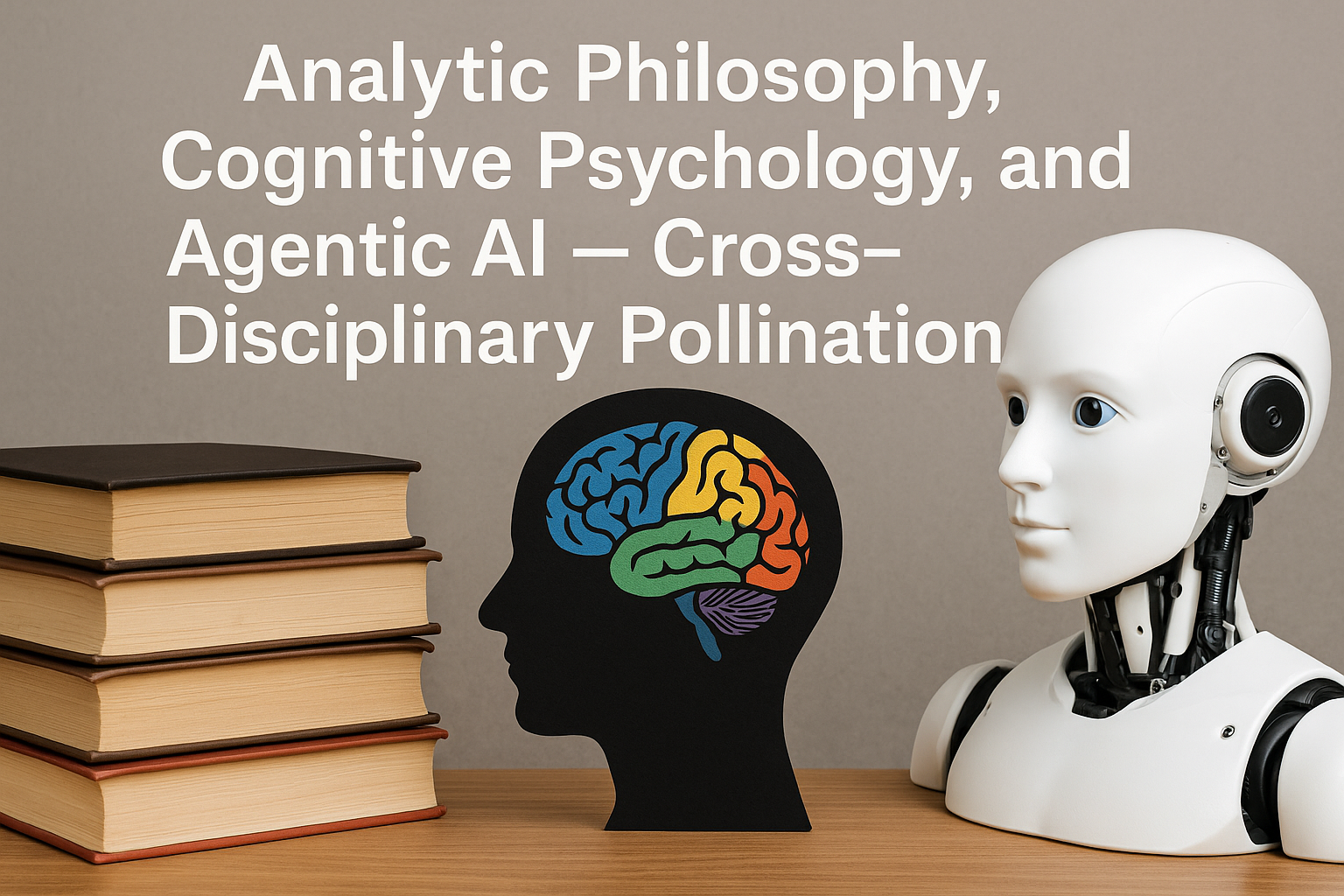
Analytic Philosophy, Cognitive Psychology, and Agentic AI — Cross Disciplinary Pollination
1. Introduction: Why Agentic AI Has Deeper Roots Than You Think
Agentic AI — systems that can reason, plan, act, and remember — is transforming how we think about intelligence. But its foundations did not begin with today’s large language models. This post explores how analytic philosophy and cognitive psychology helped shape the ideas behind modern agentic AI. The core thesis: the concepts that make agency possible — logic, representation, reasoning, memory, fast/slow thinking — were developed long before they were implemented in code. Understanding this genealogy matters because it helps explain AI’s biggest current challenges: hallucinations, weak autonomy, and shallow reasoning LinkedIn — Ryan Martin.
2. Analytic Philosophy: Building the Language of Thought
2.1 Frege, Russell, and Logical Form
Gottlob Frege’s predicate logic helped establish the idea that complex meaning can be built from simpler parts Frege’s Influence on Analytic Philosophy. Bertrand Russell’s theory of definite descriptions showed how logical analysis can resolve ambiguity Wikipedia — Analytic Philosophy. Logical atomism anticipated later approaches to knowledge representation in AI. Frege’s sense/reference distinction foreshadowed the AI problem of grounding symbols in meaning.
2.2 Logical Positivism and Formal Reasoning
The Vienna Circle emphasized clarity, precision, and empirically grounded meaning Internet Encyclopedia of Philosophy — Analytic Philosophy. Carnap’s work on logical syntax influenced formal systems for representing knowledge. These ideas helped establish the symbolic tradition in early AI.
2.3 Wittgenstein, Context, and the Limits of Static Meaning
Later Wittgenstein argued that meaning comes from use in context, not fixed definitions STRV — Language Games and LLMs. His “language games” lens maps well onto prompt engineering and human-AI interaction LessWrong — Wittgenstein and AI. His emphasis on “forms of life” raises questions about whether AI can truly understand language without shared embodiment and context Journal of Neurophilosophy — From Wittgenstein’s Language Games to LLMs.
2.4 Computational Theory of Mind
Jerry Fodor’s Language of Thought hypothesis treated thought as computation over representations Stanford Encyclopedia — Computational Theory of Mind. This framework became foundational to cognitive science and inspired AI thinking about modularity and representation. Fodor’s later skepticism about abductive and global reasoning parallels current limits in agentic AI Stanford Enclylopedia — Fodor’s Critique.
2.5 Truth Conditions and Knowledge Representation
Truth-conditional semantics connects understanding to the conditions under which statements are true Udemy — Before the Algorithm: Philosophy & Semantics of AI. That idea strongly influenced knowledge representation in AI Stanford Encyclopedia — Logic and AI. Compositionality became a core principle for semantic parsing and structured reasoning systems.
3. Cognitive Psychology: How the Mind Was Modeled
3.1 The Cognitive Revolution
The cognitive revolution replaced behaviorism with an information-processing view of the mind Stanford Encyclopedia — Computational Theory of Mind. Cognitive science emerged at the intersection of psychology, AI, linguistics, philosophy, and neuroscience. The mind was increasingly modeled as a system that perceives, stores, reasons, and acts.
3.2 Dual Process Theory: Fast and Slow Thinking
Dual-process theory distinguishes intuitive, fast thinking from deliberate, slow reasoning Structural Learning — Dual Process Theory. Kahneman popularized this model, and it has become a major influence on agent design AI Alignment Forum — Dual Process Theory. SOFAI applies this idea directly to AI by separating fast and slow solvers SOFAI — Thinking Fast and Slow in AI. SAP similarly argues that different tasks require different reasoning modes SAP — AI Agents: Thinking Fast, Thinking Slow.
3.3 Cognitive Architectures as Design Blueprints
Cognitive architecture describes how perception, memory, reasoning, and action interact in intelligent systems Sema4 — Cognitive Architecture in AI. Modern agentic systems use planning, persistent memory, and tool use in ways that echo cognitive models Moxo — Agentic AI Architecture. IBM frames agentic architecture as a system that mimics reasoning, learning, and adaptation IBM — What Is Agentic Architecture?. Core building blocks include reasoning, planning, memory, and external tool interaction Unstructured — Agentic AI Architecture.
3.4 Goals, Self-Reflection, and Learning
Recent surveys of agentic AI highlight goal formation, self-reflection, memory persistence, reasoning, and continual learning ScienceDirect — Agentic AI Systems Survey. The DPT-Agent framework operationalizes dual-process theory in language agents arXiv — Leveraging Dual Process Theory in Language Agent Framework. Fast and slow reasoning together help balance responsiveness and depth.
4. Where Philosophy and Psychology Meet Agentic AI
4.1 From Formal Logic to Computation
Analytic philosophy supplied the formal vocabulary for thinking about thought. Cognitive psychology supplied empirical models of how thinking actually happens. Agentic AI turns both into software architecture. Modern systems increasingly hybridize symbolic and neural approaches arXiv — Agentic AI: A Comprehensive Survey.
4.2 Fast and Slow Thinking as an AI Design Principle
Applying slow reasoning to every task is inefficient, just as humans do not deliberate about everything SAP — AI Agents: Thinking Fast, Thinking Slow. Agentic AI increasingly uses tiered decision-making: quick responses for simple tasks, deeper reasoning for complex ones. SOFAI is one example of this design direction SOFAI — Thinking Fast and Slow in AI.
4.3 Rationality, Agency, and Emergent Behavior
Philosophy and AI overlap strongly in questions of rational action and decision-making MIT — The Philosophical Puzzle of Rational Artificial Intelligence. IBM’s FAST workshop reflects growing interest in how agentic systems exhibit emergent behavior IBM Research — Foundations of Agentic Systems Theory.
4.4 Ethics, Responsibility, and Control
The hardest AI problems are not only technical; they are also conceptual and ethical LinkedIn — Ryan Martin. As agents act more autonomously, questions of responsibility and oversight become unavoidable. Security and authorization must be designed into every agent action PlainID — 10 Core Design Principles for Securing Agentic AI.
5. Practical Implications: What Builders Can Learn
5.1 Lessons from Philosophy
Use precise definitions for goals, constraints, and reward structures. Treat prompt interactions as contextual language games STRV — Language Games and LLMs. Design for meaning, not just surface pattern matching.
5.2 Lessons from Cognitive Psychology
Use dual-process thinking to balance speed and accuracy. Model memory more realistically with working, episodic, and semantic layers. Account for human bias and error when designing autonomous systems. Borrow useful patterns from cognitive architectures Sema4 — Cognitive Architecture in AI.
5.3 The Road Ahead
The most promising future lies in genuinely hybrid intelligence, not single-discipline solutions. Interdisciplinary education is already emerging in programs that combine philosophy, neuroscience, and AI OvGU — Philosophy, Neurosciences, AI. Agentic AI is ultimately both an engineering challenge and a conceptual one.
6. Conclusion: Key Takeaways
- Analytic philosophy gave AI its language of logic, meaning, and representation.
- Cognitive psychology gave AI its model of the mind, including memory, reasoning, and dual-process thinking.
- Agentic AI brings these ideas together in working systems.
- The future of AI depends on cross-disciplinary integration, not isolated technical progress.
- The most capable agentic systems will be built by people who understand both how minds work and how concepts are structured.
Sources
- with
- as per instruction. –>
- AI Alignment Forum – Dual Process Theory
- arXiv – Leveraging Dual Process Theory in Language Agent Framework
- arXiv – Agentic AI: A Comprehensive Survey
- MIT – The Philosophical Puzzle of Rational Artificial Intelligence
- Licentia Poetica – Frege’s Influence on Analytic Philosophy and Logic
- Stanford Encyclopedia – Logic and AI
- Stanford Encyclopedia – The Computational Theory of Mind (Fall 2018) – Fodor
- Stanford Encyclopedia – The Computational Theory of Mind (Spring 2021)
- IBM Research – Foundations of Agentic Systems Theory
- IBM – What Is Agentic Architecture?
- Internet Encyclopedia of Philosophy – Analytic Philosophy
- Journal of Neurophilosophy – From Wittgenstein’s Language Games to LLMs
- LessWrong – Is Wittgenstein’s Language Game Used When Helping AI Understand?
- LinkedIn – The 4 Future Opportunities in AI (Ryan Martin)
- Moxo – Agentic AI Architecture
- PlainID – 10 Core Design Principles for Securing Agentic AI
- OvGU – Philosophy, Neurosciences, AI (Bachelor’s Program)
- SAP – AI Agents: Thinking Fast, Thinking Slow
- Sema4 – Cognitive Architecture in AI
- SOFAI – Thinking Fast and Slow in AI
- ScienceDirect – Agentic AI Systems: A Systematic Survey
- Structural Learning – Dual Process Theory: System 1 vs System 2
- STRV – Language Games and LLMs: What Wittgenstein Can Teach AI Engineers
- Udemy – Before the Algorithm: Philosophy & Semantics of AI
- Unstructured – Agentic AI Architecture
- Wikipedia – Analytic Philosophy