What is Vibe Coding?
What Is Vibe Coding? The AI-Powered Trend Changing Software Development
I. Introduction: Why “Vibe Coding” Matters Now
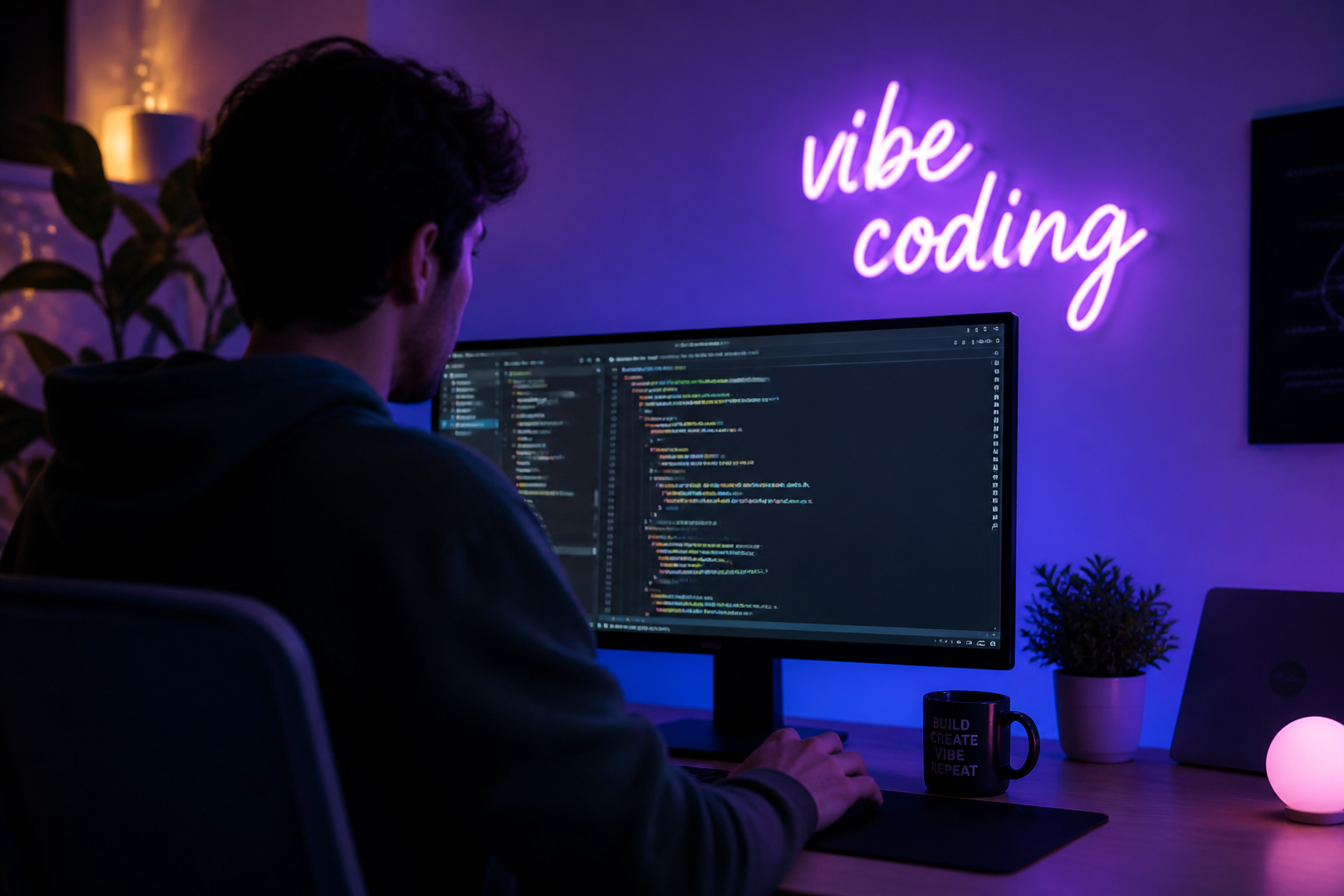
Something remarkable is happening in software development. People who have never written a line of code are building functional applications. Experienced developers are shipping prototypes in hours instead of weeks. And the catalyst for all of this is a simple shift: instead of typing commands in a programming language, you describe what you want in plain English and let artificial intelligence handle the rest.
This phenomenon has a name—vibe coding—and it was coined by one of the most respected voices in AI. In February 2025, Andrej Karpathy, former head of AI at Tesla and co-founder of OpenAI, posted a tweet that perfectly captured what was happening: developers were no longer painstakingly writing every line of code. Instead, they were “vibe coding”—describing their intentions, accepting whatever the AI produced, and iterating through conversation rather than syntax.
Why does this matter right now? Because the tools have finally crossed a threshold. Large language models have become sophisticated enough to generate production-quality code for many use cases. The result is a democratization of software creation that we haven’t seen since the rise of the internet itself. But with this democratization comes serious questions about quality, security, and responsibility.
This article will explore what vibe coding actually is, where the term came from, how it works in practice, what tools power it, and—most importantly—the benefits, risks, and future of this rapidly evolving approach to building software.
II. What Is Vibe Coding?
At its core, vibe coding is the practice of using AI tools to generate software code from natural-language prompts. Instead of writing `if (x > 10) { doSomething(); }` by hand, you type “create a function that checks if a number is greater than 10 and then runs this action.” The AI handles the translation from human language to machine language.
This represents a fundamental shift in the software development process. Traditional coding requires developers to understand syntax, data structures, algorithms, debugging techniques, and a host of other technical skills. It’s a craft that demands years of practice and deep attention to detail. Vibe coding flips this model: the developer becomes a director, not a writer. They describe the outcome they want, and the AI handles the implementation.
It’s important to recognize that vibe coding exists on a spectrum. There are two common approaches:
**Pure vibe coding** involves heavy reliance on AI with minimal human coding. The user describes what they want, the AI generates the code, and the user accepts it with little to no modification. This approach is common among non-developers building simple tools or prototypes.
**AI-assisted development** treats the AI as a collaborative partner. The developer uses prompts to generate code, but they review, modify, and optimize what the AI produces. They understand the code they’re shipping and can debug issues when they arise. This is the approach most professional developers take.
The key idea behind both approaches is the same: shifting focus from writing code line by line to describing desired outcomes. It’s a move from “how” to “what.”
III. Where Did the Term Come From?
The term “vibe coding” has a precise origin story. On February 25, 2025, Andrej Karpathy tweeted a short but powerful observation about the changing nature of software development. He described a new mode of programming where developers “fully give in to the vibes, embrace exponentials, and forget that the code even exists.”
Karpathy’s tweet resonated immediately because it articulated something that countless developers were already experiencing. The rise of tools like ChatGPT, GitHub Copilot, and Cursor had quietly transformed how many people wrote code. Karpathy simply gave it a name and captured the cultural shift.
The tweet spread rapidly through tech media and online communities. Blog posts, LinkedIn articles, and Twitter threads dissected what “vibe coding” meant and whether it was a good thing. Developers debated the term’s implications. Some embraced it as a natural evolution of the craft. Others worried it signaled a decline in coding standards.
The timing was significant. AI coding tools had reached a level of capability that made vibe coding practical for real-world use cases. What might have been dismissed as a gimmick in 2023 had become a legitimate workflow by early 2025. The term stuck because it described something real and widespread.
Karpathy’s coinage also connected to a broader shift in AI: the move toward more agentic workflows. Instead of AI being a passive tool that responds to individual queries, it was becoming an active participant in the creative process—generating, testing, and iterating on code with minimal human intervention.
IV. How Vibe Coding Works
The process of vibe coding is remarkably straightforward, which is precisely why it has gained such traction. Here’s how it typically works:
**Step 1: Describe the idea in natural language.** You start by telling the AI what you want to build. This could be as simple as “Create a landing page for my photography portfolio” or as complex as “Build a task management app with user authentication, a calendar view, and notification reminders.” The more specific you are, the better the results.
**Step 2: Let the AI generate code.** The AI responds by writing the necessary files, functions, and components. Depending on the tool, this might happen in real-time as you type, or it might generate an entire project structure in one go.
**Step 3: Test and iterate.** You review what the AI has produced—ideally by running the code and seeing if it works as expected. Then you ask for changes: “Make the buttons blue instead of green,” “Add a search bar at the top,” “Fix the error when users try to log in with an invalid email.” Each prompt refines the output.
**Step 4: Deploy or share.** Once you’re satisfied with the result, you can deploy the application, share it with others, or continue iterating.
Let’s look at a concrete example. Imagine a beginner who wants to build a simple habit tracker. With vibe coding, they might open an AI-powered tool and type:
“Create a web app where I can add habits I want to track. Each habit should have a checkbox for today. Show a streak counter for how many days in a row I’ve completed each habit. Use a clean, minimal design.”
Within minutes, the AI generates the HTML, CSS, and JavaScript needed to make this work. The user tests it, finds that the streak counter isn’t calculating correctly, and types: “The streak counter should reset to zero if I miss a day. Can you fix that?” The AI adjusts the code accordingly.
The entire process is fast, iterative, and accessible. But here’s the critical point: it still benefits from human review. The AI might produce code that works but is inefficient, insecure, or poorly structured. The more you understand about what the AI is doing, the better your results will be.
V. The Most Popular Vibe Coding Tools
The ecosystem of tools supporting vibe coding has grown rapidly. Different tools serve different purposes, and choosing the right one depends on what you’re trying to build.
**AI-native IDEs: Cursor** stands out as a purpose-built coding environment designed from the ground up for AI-assisted development. It integrates deeply with AI models, allowing you to generate, edit, and refactor code through natural language prompts. Cursor is particularly popular among developers who want a seamless, code-aware experience.
**Codebase-aware assistants: Claude Code** (from Anthropic) excels at understanding and working with existing codebases. It can analyze your project structure, understand dependencies, and make changes that fit within your existing architecture. This makes it ideal for developers who need AI help with larger, more complex projects.
**Everyday coding helpers: GitHub Copilot** remains one of the most widely used AI coding tools. Integrated directly into Visual Studio Code and other editors, it provides inline suggestions as you type. While it’s more of a completion tool than a full vibe coding experience, it represents the entry point for many developers into AI-assisted development.
**Quick prototyping tools: OpenAI Codex, ChatGPT, and Replit** offer more accessible entry points for non-developers. ChatGPT can generate code in response to natural language prompts, and you can copy-paste the results into your project. Replit provides an entire browser-based development environment with AI capabilities built in.
**Business and internal app builders: Retool and Pipedream** are designed for building internal tools and workflows. They combine AI code generation with pre-built components for connecting to databases, APIs, and other services. These are particularly useful for teams that need to quickly build custom internal applications.
**Newer experimental platforms: Lovable, Base44, and Manus** represent the cutting edge of vibe coding. These platforms are experimenting with more agentic approaches, where AI doesn’t just generate code but actively manages the entire development lifecycle—from planning to deployment.
Each tool has its strengths, and the best choice depends on your technical background, the complexity of your project, and your preferred workflow.
VI. Why Vibe Coding Is So Popular
The rapid adoption of vibe coding isn’t an accident. It addresses several fundamental needs in software development and beyond.
### 1. Lowering the Barrier to Entry
The most transformative aspect of vibe coding is that it enables non-developers to build functional software. Someone with a background in marketing, sales, or operations can now create the tools they need without waiting for engineering bandwidth. This democratization of software creation is opening doors for people who previously had no way to bring their ideas to life.
### 2. Faster Prototyping
The speed of vibe coding is remarkable. What might take a developer days or weeks to build from scratch can be generated in minutes. This allows for rapid experimentation: try an idea, see if it works, and if not, pivot quickly. For startups and product teams, this acceleration means less time spent on boilerplate and more time validating assumptions.
### 3. Lower Cost and Smaller Teams
Vibe coding reduces the need for large engineering teams, especially in the early stages of a project. Solo founders can build MVPs that would have required a team of developers a few years ago. Internal tools that previously required dedicated engineering resources can now be built by a single person with AI assistance.
### 4. Empowering Teams Beyond Engineering
This is perhaps the most underappreciated benefit. Marketing teams can build landing pages and analytics dashboards. Sales teams can create custom CRM views. Support teams can automate common workflows. Operations teams can build tools to track metrics. By reducing dependency on engineering for simple use cases, vibe coding lets technical teams focus on more complex, high-impact work.
### 5. Learning Through Building
Vibe coding is also an incredibly effective learning tool. Beginners can see what the AI generates, modify it, and learn from the results. They can ask questions like “Why did you use this function?” or “Can you explain what this line does?” The AI becomes a patient, always-available tutor. This hands-on, experimental approach to learning is far more engaging than traditional tutorials or documentation.
VII. The Risks and Limitations
For all its promise, vibe coding comes with significant risks that cannot be ignored. The enthusiasm for speed and accessibility must be balanced with a clear-eyed understanding of the potential downsides.
### 1. Security Concerns
AI-generated code can introduce vulnerabilities that even experienced developers might miss. The AI might use outdated libraries, implement insecure authentication, or leave API keys exposed in the code. Without proper security review, these vulnerabilities can be catastrophic, especially if the code is deployed to production. Never trust AI-generated code blindly—always review it with security in mind.
### 2. Code Quality and Technical Debt
AI can produce code that works now but is poorly structured, difficult to maintain, or inefficient. This creates technical debt that accumulates over time. A project built entirely through vibe coding might function perfectly for months, only to become impossible to extend or debug when issues arise. Long-term maintainability requires intentional design, which AI doesn’t always prioritize.
### 3. Lack of Understanding
The most dangerous risk of vibe coding is that users ship code they don’t understand. When something breaks—and it will—they have no way to diagnose or fix the problem. They become dependent on the AI to handle every issue, which can be frustrating and inefficient. True understanding of the code you’re shipping is not optional; it’s essential for responsible development.
### 4. Governance and Shadow IT
When non-technical users start building and deploying applications without oversight, it creates “shadow IT”—software that exists outside the organization’s governance structures. These apps might mishandle sensitive data, violate compliance requirements, or lack proper authentication. Organizations need clear policies about what can be built with vibe coding and how it should be reviewed.
### 5. Not Right for Every Use Case
Vibe coding excels at prototypes, internal tools, and low-risk applications. It is not appropriate for critical systems like medical devices, financial trading platforms, or infrastructure that handles sensitive data. The stakes are simply too high to trust code that hasn’t been carefully reviewed and tested by experienced developers.
VIII. Real-World Use Cases
Despite these risks, vibe coding is already proving valuable across a wide range of applications.
### For Individuals
Personal projects are where vibe coding shines. Individuals are building:
– Personal finance trackers that connect to their bank accounts
– Habit trackers with custom metrics and visualizations
– Portfolio websites and landing pages with minimal effort
– Simple productivity automations, like email sorting or file organization
These projects are low-risk, and the satisfaction of building something functional is immense.
### For Businesses
Organizations are using vibe coding for internal tools that improve efficiency without requiring dedicated engineering resources:
– Internal dashboards that aggregate data from multiple sources
– Custom CRMs tailored to specific sales processes
– Workflow automation for repetitive tasks like data entry or report generation
– Sales and customer support tools that integrate with existing systems
– Rapid prototyping of product features before committing to full development
### For Entrepreneurs
Startup founders are finding vibe coding invaluable for the early stages of building a company:
– Building MVPs quickly to test market demand
– Validating ideas before hiring a full engineering team
– Launching simple products with minimal overhead and burn rate
– Creating demos and prototypes for investor presentations
The ability to ship something functional in days instead of weeks is a game-changer for early-stage startups operating on limited resources.
IX. What Comes Next After Vibe Coding?
Vibe coding is not the final destination. It’s a step toward a more evolved approach to software development that combines the best of human creativity with AI’s ability to execute.
The next phase is already emerging: **agentic engineering**. Instead of loose prompting, developers will work with AI agents that follow specifications, maintain context across sessions, and handle complex tasks autonomously. The shift is from “ask and hope” to “specify and direct.”
This means developers will spend less time writing boilerplate code and more time:
– Defining clear specifications and requirements
– Reviewing and validating AI-generated code
– Directing AI agents toward specific outcomes
– Handling edge cases and complex logic that AI struggles with
– Ensuring security, performance, and maintainability
For leaders and organizations, now is the time to prepare. Here’s what to do:
**Set governance rules.** Define what types of projects can use vibe coding, what review processes are required, and who is responsible for security and compliance.
**Start with low-risk projects.** Let teams experiment with internal tools and prototypes before moving to customer-facing applications.
**Train teams in AI literacy.** Every developer should understand how to prompt effectively, how to evaluate AI output, and how to spot potential issues.
**Balance speed with discipline.** The goal is not to eliminate human oversight but to use AI to accelerate the parts of development that don’t require deep expertise.
The term “vibe coding” may fade as the approach becomes normalized. But the underlying shift—from writing code to directing AI systems—is here to stay.
X. Conclusion: Key Takeaways
Let’s recap what we’ve covered:
– **Vibe coding** is the practice of using AI to turn natural-language prompts into working software. It represents a fundamental shift in how software is created.
– **It is changing who can build software.** Non-developers can now create functional applications, and experienced developers can work faster than ever before.
– **The biggest benefits** are speed, accessibility, and the ability to experiment rapidly. Vibe coding lowers barriers and empowers teams to build what they need.
– **The biggest risks** are security vulnerabilities, poor code quality, lack of understanding, and governance challenges. These risks must be managed carefully.
– **The smartest approach** is to use vibe coding for the right projects—prototypes, internal tools, and low-risk applications—with human review and strong guardrails.
The future of software development is not just about writing code. It’s about directing AI systems responsibly, understanding what they produce, and making intentional choices about when to accelerate and when to slow down. Vibe coding is a powerful tool, but like any tool, its value depends on how wisely it’s used.
The question is no longer whether AI will change how we build software. It’s how well we’ll adapt to the change.