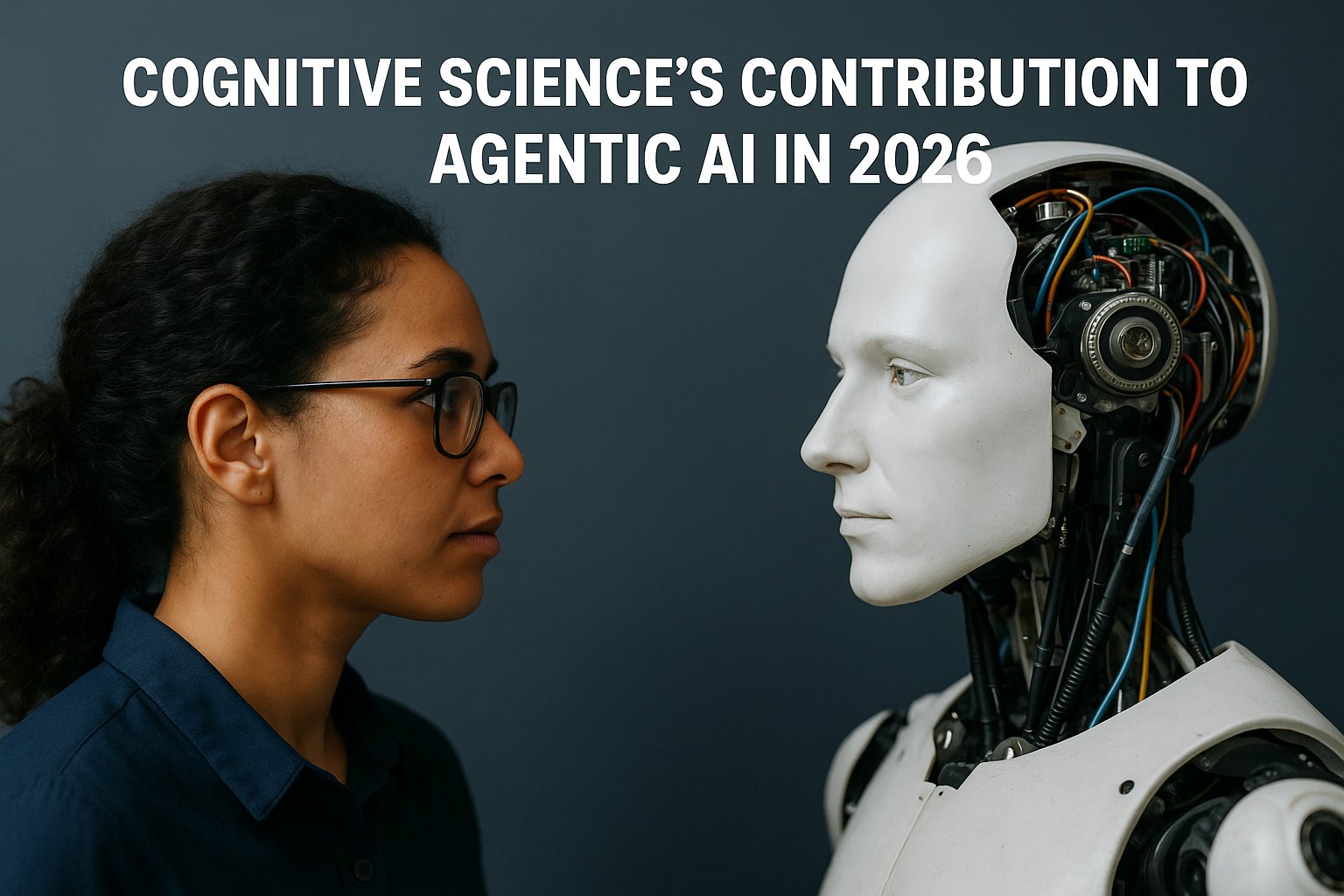
Cognitive Science’s Contribution to Agentic AI in 2026
Why Cognitive Science Is the Secret Ingredient in Agentic AI (2026)
In 2026, the biggest breakthroughs in agentic AI are not coming from engineering alone—they’re coming from cognitive science. As AI systems evolve from task executors into autonomous collaborators, researchers are increasingly drawing on theories of agency, embodiment, memory, and social cognition to build agents that can reason, decide, and work with humans more naturally.
Agentic AI is shifting from narrow assistants to high-productivity digital peers that can manage complex workflows SDG Group. Major AI events in 2026 are explicitly emphasizing interdisciplinary work that connects AI and cognitive science IEEE ICA 2026. The central question has moved from “Can AI act?” to “Can AI decide, plan, and collaborate like a mind?”
Understanding Agency: From Human Volition to Machine Decision-Making
Cognitive science has long studied the Sense of Agency (SoA)—the feeling of controlling one’s actions and their outcomes Frontiers in Psychology, 2026. A 2026 framework breaks agency into three levels: outcome-level agency, action-level agency, and decision-level agency PMC / Frontiers in Psychology. This decision-level view is especially relevant for AI agents that must do more than execute instructions—they must deliberate, commit, and revise intentions. Executive function research helps explain how agents can self-monitor, plan, and adapt goal-directed behavior AI Alignment Forum.
Embodied Cognition: Why Agents Need Grounding
Embodied cognition is becoming a practical design principle for AI in 2026, not just a psychological theory Daniel Lemire’s Blog. The core idea is that intelligence emerges through interaction with an environment, not just from abstract computation alone Daniel Lemire’s Blog. IEEE’s 2026 special topic on agentic AI and embodied cognition highlights how agents, learners, and physical or virtual environments continuously co-adapt IEEE Education Society. Applications include:
- XR and VR learning environments grounded in sensorimotor principles
- Robotic agents that rely on world models rather than static rules arXiv
- Embodied AI in domains like eldercare, firefighting, and construction Forbes
Theory of Mind: Building Agents That Understand Other Minds
Theory of Mind (ToM)—the ability to infer beliefs, goals, and intentions in others—is now being engineered into agentic systems Springer Handbook of Human-Centered AI, 2026. The ToM4AI workshop under AAAI reflects the growing importance of social reasoning in multi-agent AI AIhub. Research from MIT and related groups uses probabilistic models to represent other agents as approximate rational decision-makers MIT Schwarzman College / YouTube.
Why it matters:
- Multi-agent coordination depends on predicting other agents’ behavior
- Human-AI collaboration improves when AI can infer human intent
- Benchmarks like Decrypto are pushing ToM reasoning in multi-agent settings ICLR Workshop
Cognitive Architectures: Designing the “Executive Layer” of AI
In 2026, cognitive architectures are increasingly modeled on human executive functions such as planning, inhibition, and cognitive control Medium / Neuroscience Behind Agentic AI. The executive layer in modern agents is often compared to the prefrontal cortex because it can override reflexive responses and steer goal-directed action Medium. Common architecture patterns include:
- Persistent memory systems for episodic and semantic recall Taskade
- Goal decomposition engines for breaking complex objectives into sub-tasks Unstructured.io
- Error correction loops informed by dual-process theory Taskade
Cognitive architecture is what separates a scripted chatbot from an agent that can handle ambiguity Quiq.
Human-AI Teaming: From Tool Use to Collective Intelligence
Cognitive science is helping define a formal science of human-AI teaming, combining behavioral experiments with computational modeling PNAS Nexus, Gonzalez et al. 2026. Research at Carnegie Mellon is developing a complementarity framework to determine when humans or AI should lead decisions CMU Tepper School. Key insights from 2026:
- AI teammates can reduce coordination and trust if transparency is lacking ScienceDirect
- Trust may decline over time after an initial overestimation period ScienceDirect
- Human and AI systems are increasingly studied as hybrid cognitive systems that co-adapt over time arXiv | Network Science Synthesis
The main bottleneck is not just AI performance—it is the cognition of the team as a whole.
Verifiable AI and Explainable Autonomy
As agentic systems gain autonomy, transparency and governance become essential SearchUnify. Cognitive science offers explainability tools rooted in how people understand causation, intention, and responsibility:
- Decision-level agency provides vocabulary for explaining why a system chose an action Frontiers in Psychology
- Theory of Mind models help humans anticipate what an agent is likely to do next
Regulatory pressure, including the EU AI Act, increases the need for auditable autonomy IBM / YouTube. Trustworthy agentic AI depends on combining capability with verifiability.
Future Directions and Open Questions
World models are emerging as the next frontier for agents that build internal representations of their environment AAMAS 2026 Blue Sky Award. Affective computing and emotional modeling may enable richer human-AI interaction IBM / YouTube. Neuromorphic hardware paired with cognitive architectures may lead to increasingly self-directed forms of intelligence Forbes.
Open ethical questions remain:
- How do we protect human decision-level agency in AI-mediated environments? PMC
- Can agents ever achieve genuine social intelligence rather than simulated Theory of Mind? Santa Fe Institute
Conclusion: Key Takeaways
- In 2026, cognitive science is not a side influence on agentic AI—it is becoming a core design discipline
- The most important advances are coming from ideas like agency, embodiment, Theory of Mind, cognitive architecture, and human-AI teaming
- The future of agentic AI will depend on whether builders can create systems that are not only capable, but also grounded, interpretable, socially aware, and trustworthy
- Organizations that succeed will treat cognitive science as essential infrastructure for building the next generation of agentic systems
Sources
- Frontiers in Psychology / PMC – Full Text: Reconceptualizing the Sense of Agency
- Frontiers in Psychology / PMC – Reconceptualizing the Sense of Agency: Decision-level Agency in the Era of Generative AI (Feb 2026)
- Santa Fe Institute – The Nature of Intelligence: Cognitive Science Perspectives on AGI (2026)
- arXiv – Collective Cognition in Hybrid Groups: A Network Science Synthesis
- arXiv – Embodied AI Agents: Modeling the World
- Blue Prism – Future of AI Agents: Top Trends in 2026
- CMU Tepper School – Framework Grounded in Collective Intelligence for Human-AI Teams
- Daniel Lemire – Embodied Cognition and Agentic AI (May 2026)
- Deloitte – AI and the Future of Human Decision-Making (2026)
- Forbes – Beyond Agentic AI: The Emergence of Cognitive AI Ecossystems (July 2026)
- AIhub – AI and Theory of Mind: An Interview with Nitay Alon
- IBM / YouTube – AI Trends 2026: Quantum, Agentic AI & Smart Automation
- ICLR 2026 Workshop – From Human Cognition to AI Reasoning
- IEEE ICA 2026 Main Track – Foundations of Agentic AI
- IEEE Education Society – Special Topic: Agentic AI and Embodied Cognition
- Medium – Architecting Autonomy: The Neuroscience Behind Agentic AI Systems
- MIT / YouTube – Human Intelligence & AI: Cognitive Modeling Approaches (Josh Tenenbaum)
- MSDynamicsWorld – 10 Transformative Agentic AI Trends in 2026
- AI Alignment Forum – Capabilities and Alignment of LLM Cgognitive Architectures
- PNAS Nexus (Gonzalez et al. 2026) – Toward a Science of Human-AI Teaming for Decision Making
- Quiq – Cognitive Architecture Explained: How Intelligent Agents Think (Mar 2026)
- Science – “Agentic AI and the Next Intelligence Explosion” (March 2026)
- SDG Group – “Agentic AI 2026: From Assistants to High-Productivity Digital Peers”
- SearchUnify – “7 Agentic AI Trends Reshaping Enterprise Support in 2026”
- ScienceDirect – “AI-Teaming: Redefining Collaboration in the Digital Era”
- Springer – “Theory of Mind in Human-AI Interaction and AI” (Handbook of Human-Centered AI, 2026)
- Taskade – “The Cognitive Turn: Why Modern AI Is Rooted in Psychology (2026)”
- Unstructured.io – “Agentic AI Architecture: Defining the Autonomous Enterprise”