What is Harness Engineering?
What Is Harness Engineering? Exploring the Two Worlds Behind a Critical Discipline
Introduction
“Harness engineering” sounds like a niche term, something only a specialist would use. But in reality, it refers to two distinct, equally important fields that are quietly shaping the technology we rely on every day. On one side, there is traditional wire harness engineering—the discipline behind the bundles of cables that power everything from cars to medical devices. On the other, there is the emerging world of AI harness engineering—the scaffolding that makes artificial intelligence safe, reliable, and useful in real-world systems.
Both of these fields share a common goal: creating the hidden systems that organize, connect, and control complex components so that the end result is dependable, safe, and efficient. This article will explore each definition, compare them side by side, and explain why harness engineering—in both its forms—matters more than ever as technology grows more intricate.
What Is Harness Engineering?
At its simplest, harness engineering is the design of a system that organizes, connects, and controls complex components. The term “harness” comes from the idea of a framework that holds everything together, channels power and signals, and ensures that the whole assembly works as intended. Whether you are dealing with physical wires or digital models, the core concept is the same: creating order out of potential chaos.
The beauty of the term is that it applies naturally in both physical and digital contexts. In the physical world, a wire harness is a structured assembly of cables, connectors, and terminals. In the digital world, an AI harness is a set of software components—prompts, APIs, guardrails, and memory systems—that manage how an AI model behaves and interacts with the outside world. Let’s dive into each branch.
Traditional Harness Engineering: Wire Harness Design
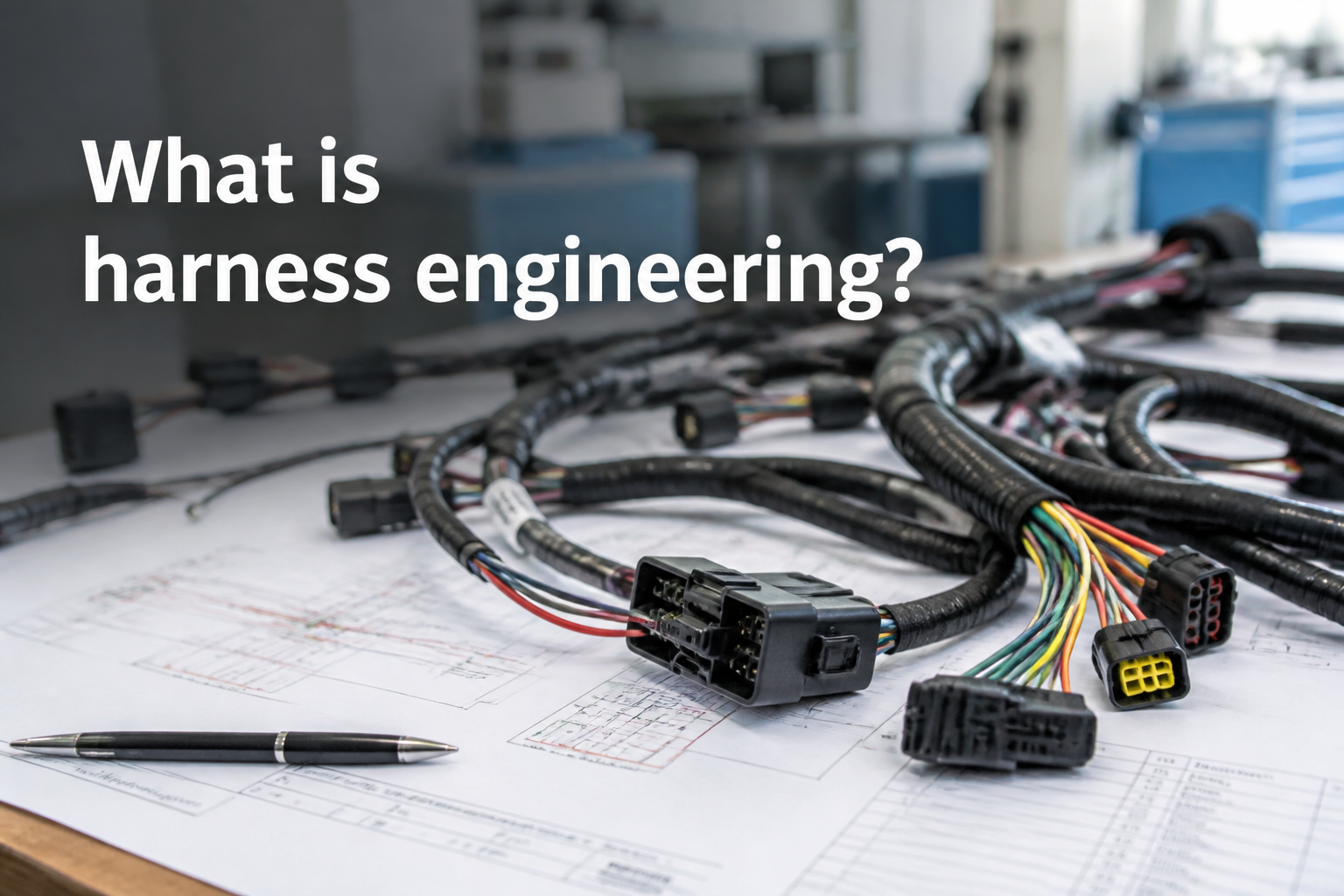
A wire harness (also called a cable harness or wiring assembly) is a collection of wires, cables, connectors, and terminals bound together to transmit electrical power and signals. Its purpose is to replace loose, tangled wires with a neat, organized, and protected bundle that can be installed quickly and reliably.
Core responsibilities in wire harness design include:
– **Wire routing and layout** – determining the most efficient and safe path for each wire.
– **Connector and terminal selection** – choosing the right interfaces to match the system’s electrical and mechanical requirements.
– **Material and insulation choices** – selecting wires, sleeves, and tapes that can withstand temperature, vibration, and chemicals.
– **Electrical integrity and durability** – ensuring the harness meets current, voltage, and signal integrity specs.
– **Documentation and manufacturing support** – creating schematics, 3D models, and assembly instructions.
Industries that rely heavily on wire harnesses include:
– **Automotive** – every modern vehicle contains dozens of harnesses for power, sensors, infotainment, and safety systems.
– **Aerospace and defense** – aircraft, satellites, and military equipment demand extreme reliability.
– **Robotics and automation** – industrial robots and factory lines depend on flexible, durable harnesses.
– **Consumer electronics** – from laptops to home appliances, internal wiring is organized into harnesses.
– **Medical devices** – patient monitors, surgical tools, and imaging machines require meticulously designed cables.
Emerging Harness Engineering: AI and Agent Infrastructure
AI harness engineering is a younger but equally critical discipline. It refers to the software infrastructure that sits around an AI model—especially large language models (LLMs) and AI agents—to make them usable in real-world applications. It goes far beyond simple prompt engineering, which focuses on crafting the best text input.
AI harness engineering controls how the model behaves, what tools it can access, and how it handles context and memory. Its key roles include:
– **Controlling model behavior** – using system prompts, instructions, and constraints to guide outputs.
– **Connecting tools and APIs** – enabling the AI to call external services, databases, or computational functions.
– **Managing memory and context** – deciding what information the model retains across interactions.
– **Improving safety and reliability** – implementing guardrails that prevent harmful or nonsensical outputs.
– **Supporting multi-step workflows and agent orchestration** – allowing the AI to break down complex tasks and chain actions.
Key Components of an AI Harness
An effective AI harness typically includes:
– **System prompts and instructions** – the foundational rules that define the model’s persona, constraints, and objectives.
– **Tool integration and APIs** – a library of functions the model can call, such as web search, database queries, or code execution.
– **Context and memory management** – short-term conversation history and long-term storage for user-specific data.
– **Control flow and orchestration** – logic that determines the sequence of steps, including conditional branching and error handling.
– **Guardrails and safety mechanisms** – filters that block toxic content, detect hallucinations, or prevent misuse.
– **Observability and tracing** – logging and monitoring to understand why the model behaved a certain way.
– **Sandboxing and secure execution environments** – isolating the model’s actions to prevent unintended side effects.
Traditional vs. AI Harness Engineering
Though they operate in different realms, the two branches of harness engineering share a deep similarity. Let’s compare them:
| Aspect | Traditional Wire Harness | AI Harness |
|——–|————————–|————|
| **Materials** | Wires, connectors, insulation, protective tubing | Code, APIs, prompts, AI models, configuration files |
| **Goals** | Reliable power and signal transmission | Reliable, safe, and useful AI behavior |
| **Design tools** | CAD software, simulation tools, PLM systems | Prompt engineering frameworks, orchestration platforms, MLOps tools |
| **Testing methods** | Electrical continuity, insulation resistance, thermal cycling | Unit tests, red-teaming, A/B testing, drift monitoring |
| **Industries** | Automotive, aerospace, robotics, medical, electronics | Enterprise software, healthcare, finance, customer service |
| **Main challenges** | Manual assembly, quality control, supply chain complexity | Model unpredictability, context limits, lack of standards |
The shared theme is clear: both fields are about making complex systems dependable. They transform a tangle of components (wires or code and models) into a structured, manageable whole.
Why Harness Engineering Matters
Traditional harness engineering is essential for the electrification of our world. As electric vehicles, renewable energy, and automation expand, the demand for reliable wire harnesses grows. And these harnesses themselves are increasingly designed and optimized using AI, creating a feedback loop between the two disciplines.
AI harness engineering, meanwhile, is critical for the safe and scalable deployment of AI. Without a proper harness, an AI model can produce unreliable outputs, leak sensitive data, or fail in unpredictable ways. As AI agents become more autonomous, the harness becomes the difference between a helpful assistant and a dangerous tool.
Both forms of harness engineering share a common importance: they ensure reliability, performance, and safety. They are the hidden layers that end users never see, but without which the technology would fall apart.
Real-World Applications
– **Automotive** – Wire harnesses connect every electrical component in a vehicle, while an AI harness might power a smart in-car assistant that can control navigation, climate, and entertainment.
– **Healthcare** – AI systems used for diagnosis or patient triage require a robust harness to ensure outputs are accurate and safe, backed by medical data integration.
– **Enterprise AI** – Customer support chatbots, coding assistants, and workflow automation tools all rely on AI harnesses to manage tool access, memory, and compliance.
– **Industrial robotics** – Physical wiring harnesses deliver power and signals to robotic arms, while AI-driven control systems orchestrate complex manufacturing sequences.
– **Finance and legal** – AI harnesses enforce strict guardrails for regulatory compliance, preventing the model from generating advice that could violate laws.
Skills and Career Opportunities
For traditional harness engineering, key skills include:
– Electrical and mechanical engineering fundamentals
– Proficiency with CAD and routing software (e.g., SolidWorks, CATIA, EPLAN)
– Knowledge of materials, manufacturing processes, and quality standards
For AI harness engineering, the skill set is different:
– Software engineering (Python, TypeScript, or similar)
– Understanding of AI/ML concepts, especially LLMs and agents
– Experience with APIs, frameworks (LangChain, LlamaIndex), and DevOps/MLOps
– Knowledge of safety, ethics, and governance around AI
Career outlook is strong in both areas. As hardware becomes more electrified and software becomes more intelligent, professionals who can design and maintain these hidden systems will be in high demand.
Challenges and Future Trends
**Traditional harness engineering** faces challenges such as:
– Manual assembly bottlenecks, especially in low-volume or custom products
– Quality control issues like miswiring, connector damage, or insulation failures
– Complex global supply chains for connectors and specialized materials
**AI harness engineering** struggles with:
– Model unpredictability – even with careful prompts, LLMs can produce unexpected outputs
– Context limits – most models have a maximum token window, restricting long interactions
– Lack of standards – no universal framework for designing or evaluating AI harnesses
**Future trends** point toward:
– **AI-assisted design** – using generative AI to optimize wire routing and material selection
– **Self-improving agent harnesses** – AI systems that learn from user feedback to adjust their own behavior
– **Greater standardization and governance** – industry-wide best practices for both hardware and AI harnesses
– **Convergence** – AI tools will increasingly be used in physical engineering workflows, linking the two worlds
Conclusion
Harness engineering, in its two forms, is about building the hidden systems that make technology work. Whether it’s a bundle of wires inside an electric vehicle or the software scaffolding around an AI agent, the goal is the same: turning complexity into something reliable, safe, and useful.
As technology continues to advance—becoming more connected, more automated, and more intelligent—the importance of harness engineering only grows. The next time you get into a car, ask a smart assistant a question, or rely on a medical device, remember that a well-designed harness is probably the reason everything works so smoothly.
Whether in copper wiring or AI infrastructure, harness engineering is becoming more important as technology grows more complex. And that is a discipline worth understanding—and investing in.