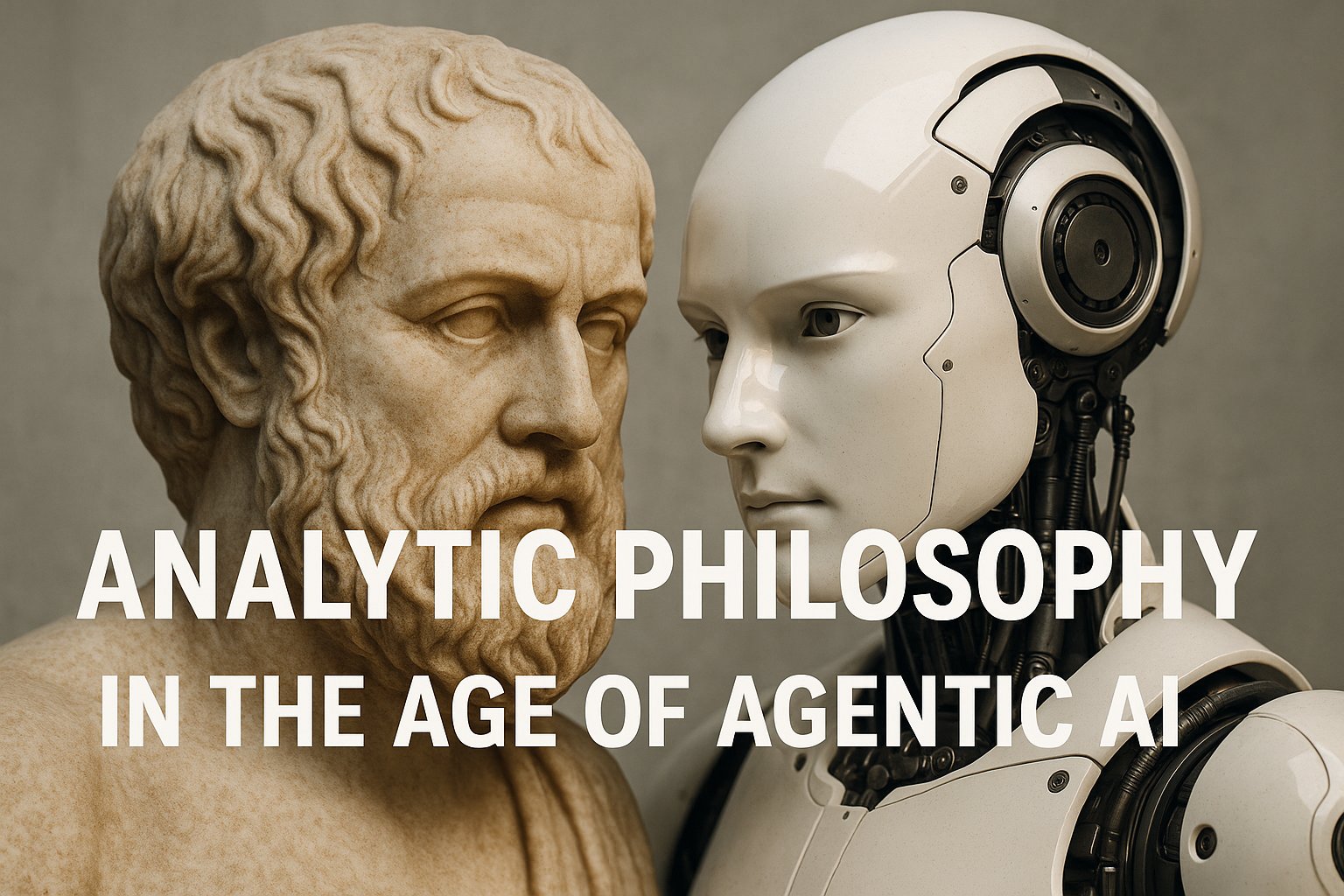
Analytic Philosophy in the Age of Agentic AI
I. Introduction — Why Agentic AI Forces a Philosophical Reckoning
Artificial intelligence is moving beyond chatbots into systems that plan, decide, and act with minimal human oversight. This shift raises a deeper question than “what can AI do?”: what counts as agency, understanding, and responsibility when machines act autonomously? Agentic AI is not just an engineering breakthrough; it is a conceptual challenge for philosophy. Analytic philosophy offers tools for thinking clearly about logic, meaning, mind, intention, and moral accountability. The analytic tradition is uniquely equipped to help us understand and evaluate the rise of agentic AI because its core concerns map directly onto the problems autonomous systems create.
II. What Is Agentic AI? A Primer for Philosophers
Agentic AI refers to systems that can pursue goals, use tools, adapt to changing conditions, and complete multi-step tasks with limited human prompting MIT Sloan Review. Key characteristics include task automation, goal-directed reasoning, adaptability, self-improvement, and interactive tool use UC News. This differs fundamentally from generative AI: generative AI responds to prompts, whereas agentic AI proactively executes plans and workflows Orkes. Once systems can act autonomously, the question becomes: when, if ever, should we call them agents? That is why philosophers should care.
III. Frege, Russell, and the Logic of Machine Reasoning
The analytic tradition began with Frege and Russell’s efforts to formalize reasoning through logic. Modern AI systems depend on formal structure, rule-like operations, and representations that invite comparison with logical analysis. Logical positivism and the analytic-synthetic distinction anticipated modern questions about what AI can genuinely know versus what it merely processes Wikipedia: Logical Positivism. If AI can manipulate symbols according to rules, the next question is whether it can understand what those symbols mean.
IV. Wittgenstein and the Problem of Meaning in AI Communication
Wittgenstein’s later philosophy shows that meaning comes from use in context, not from isolated definitions. AI systems operate by patterning language within contexts, making Wittgenstein’s “language games” especially relevant LessWrong. Important concepts include language games (meaning depends on social practice), forms of life (language is embedded in lived activity), and family resemblances (categories may lack a single essence). For agentic AI, multi-agent systems create new communication environments. This raises questions about symbol grounding, context, and whether AI language is genuinely meaningful or only functionally useful Language Games in the Age of AI.
V. Searle’s Chinese Room and the Question of Understanding
Searle’s Chinese Room Argument asks whether symbol manipulation alone can produce genuine understanding Stanford Encyclopedia. The key distinction is between syntax (formal symbol manipulation) and semantics (actual meaning or understanding). Even highly capable agentic AI may appear to understand while merely executing sophisticated procedures. Major replies include the Systems Reply and the Brain Simulator Reply IEP: Chinese Room Argument. Whether AI “understands” may matter ethically, especially when systems make consequential decisions Forbes.
VI. AI Alignment as an Analytic Philosophy Problem
The alignment problem is not only technical; it is about intention, specification, value, and interpretation Wikipedia: AI Alignment. Key distinctions include outer alignment (are we specifying the right objective?) and inner alignment (is the system actually pursuing that objective?). These questions echo analytic debates about rule-following, normativity, and the gap between intended meaning and actual behavior. Solving alignment requires clarity about what we mean by “good,” “goal,” and “success” Springer: AI, Values, and Alignment.
VII. Agency, Autonomy, and Moral Responsibility
As AI systems become more autonomous, we need sharper distinctions between different kinds of agency. Useful distinctions include instrumental agency vs. autonomous agency, and simulated agency vs. genuine agency. Conceptual analysis helps clarify what counts as action, decision, intention, and responsibility in artificial systems Medium: Philosophy of Agentic AI. If systems can revise goals or act with partial independence, where does accountability belong—designer, deployer, user, or system? Frontiers: From Logic to Goal-Directed Reasoning.
VIII. Why Analytic Philosophy Dominates AI Discourse
Analytic philosophers are highly visible in AI ethics, alignment, and consciousness debates The Analytic Monopoly on AI Philosophy. This happened because AI problems often involve logic, decision theory, epistemology, and conceptual precision. However, this dominance may crowd out other traditions that could offer valuable perspectives AI Alignment Forum. If analytic philosophy explains why AI is intelligible, it may also shape how AI is built, governed, and trusted.
IX. Philosophy as a Competitive Advantage in the AI Era
Philosophical training may become a practical advantage in designing trustworthy AI systems MIT Sloan Review. Three high-value dimensions are teleology (what should AI aim at?), epistemology (what counts as knowledge or evidence for AI?), and ethics (how should AI weigh values and trade-offs?). Organizations that understand these questions will likely build systems that are more explainable, interpretable, and governable. AI strategy increasingly depends on philosophical clarity, not just computational power.
X. Conclusion — The Analytic Toolkit for an Autonomous Future
Agentic AI is not merely a technological development; it is a live test of longstanding philosophical questions about mind, meaning, agency, and responsibility. Wittgenstein helps us think about meaning, context, and communication. Searle forces us to ask whether AI understands or only simulates understanding. Frege and Russell illuminate the importance of logic, structure, and specification. Analytic philosophy gives us the conceptual precision needed to think clearly about alignment, autonomy, and accountability. The central question is not only whether machines can think, but what kinds of agents we are creating—and whether we are prepared to live with them.
Sources
- AI Alignment Forum – AI Alignment and Philosophical Pluralism
- Forbes – Can AI Understand? The Chinese Room Today
- Internet Encyclopedia of Philosophy – Chinese Room Argument
- Ken Moriwaki – Language Games in the Age of AI
- LessWrong – Wittgenstein’s Language Game and AI
- University of Cincinnati – What is agentic AI?
- MIT Sloan Review – Philosophy Eats AI
- MillerMan School – The Analytic Monopoly on AI Philosophy
- Medium – The Philosophy of Agentic AI
- Orkes – Agentic AI Explained: Workflows vs. Agents
- Springer – AI, Values, and Alignment
- Stanford Encyclopedia of Philosophy – John Searle’s Chinese Room Argument
- Wikipedia – AI Alignment
- Wikipedia – Logical Positivism