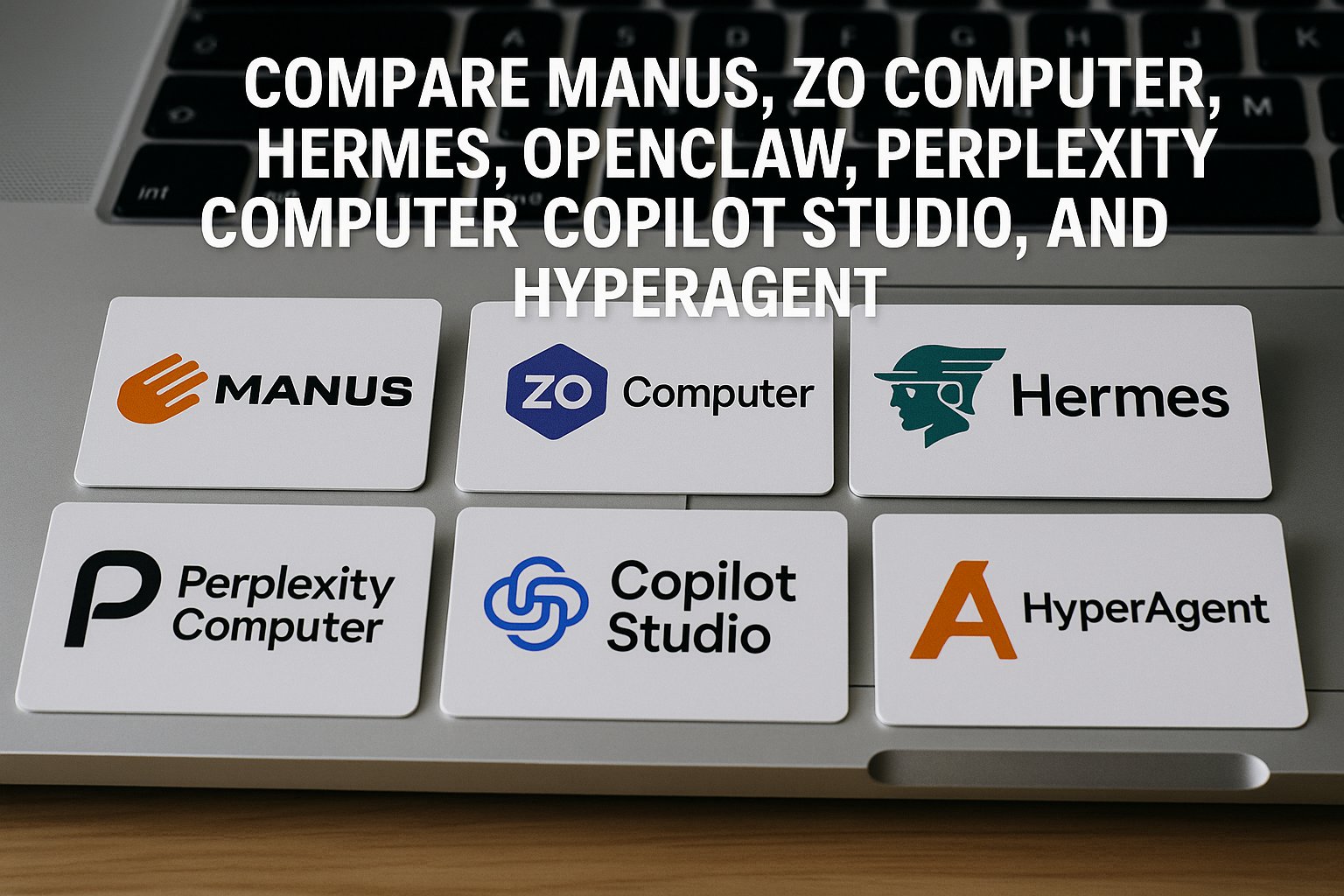
Compare Manus, Zo Computer, Hermes, OpenClaw, Perplexity Computer, Copilot Studio, and HyperAgent
Quick Reference Comparison Table
| Feature | Manus | Zo Computer | Hermes | OpenClaw | Perplexity Computer | Copilot Studio | HyperAgent |
|---|---|---|---|---|---|---|---|
| Type | Cloud autonomous agent | Personal cloud computer | Open-source self-hosted agent | Open-source self-hosted agent | Managed cloud agent | Low-code enterprise agent builder | Cloud orchestration platform |
| Autonomy Level | Fully autonomous | Semi-autonomous | Fully autonomous | Semi-autonomous | Fully autonomous | Configurable | Fully autonomous |
| Open Source | ❌ Proprietary | ❌ Proprietary | ✅ MIT License | ✅ MIT License | ❌ Proprietary | ❌ Proprietary | Partial |
| Best For | Complex long-running tasks | Personal infrastructure | Developers and MLOps | Chat-first power users | Research-heavy work | Enterprise workflows | SMBs and agencies |
| Pricing Signal | Premium / acquisition-driven future pricing | Trial to paid | Free + infra/API costs | Free + infra/API costs | ~$200/month | Microsoft licensing | Usage-based |
Platform Deep Dives
1. Manus — The Fully Autonomous Cloud Agent
Manus is a cloud-based autonomous AI agent designed to bridge thought and action (Wikipedia). It runs asynchronously in the cloud, reducing the need for constant prompting (WorkOS Blog). Using a multi-agent architecture and a robust tool-calling framework (Arxiv Paper), Manus handles tasks like trip planning, resume screening, stock analysis, and exporting multi-file outputs. What sets it apart is its strong autonomy, offering a “brain-off” experience for complex tasks. It is best suited for users who want high-autonomy execution with minimal setup.
2. Zo Computer — Your Personal AI Cloud Computer
Zo Computer is a personal AI cloud computer that combines agent behavior with a user-owned environment (Official Site). It provides an AI-powered server for apps, automations, and personal data. Built-in tools include chat, media generation, and transcription (Cerebral Valley), and it supports scheduled tasks that run continuously. Zo Computer stands out by blending hosting, automation, and AI into one managed personal workspace. It’s ideal for individuals who want a personal cloud environment with built-in automation.
3. Hermes Agent — The Self-Improving Open-Source Agent
Hermes Agent is an open-source autonomous agent built by Nous Research and designed to run on your own server (Official Site). It features persistent memory that helps it learn from prior work (Hermes Agents Network). Installation is straightforward across Linux, macOS, and WSL2, and it connects to many platforms including Telegram, Discord, Slack, WhatsApp, Signal, Email, and CLI. A distinctive capability is spawning subagents for isolated workstreams (Stackademic). Hermes excels in strong privacy, local control, and long-term improvement, making it a top choice for developers, MLOps teams, and privacy-focused users.
4. OpenClaw — The Viral Open-Source Messenger Agent
OpenClaw is a self-hosted agent runtime and message router built for chat-native control (Official Site). It connects AI models to messaging platforms like WhatsApp, Discord, Telegram, and Signal (DigitalOcean). The platform offers a large library of preconfigured skills for shell, files, and web automation, and runs as a local or self-hosted service. Its enormous popularity stems from flexibility and a chat-first interface. However, users should be aware of security concerns and CVEs that highlight the need for careful configuration (Innfactory). OpenClaw is best for power users who want chat-first agent control and don’t mind setup.
5. Perplexity Computer — The General-Purpose Digital Worker
Perplexity Computer is Perplexity’s cloud-based digital worker for browsing, file work, and multi-step task execution (Official Product Page). It orchestrates subtasks across multiple models (Ars Technica), uses computer-use behavior to click, type, and navigate apps, and can run for long periods with limited supervision. Its strength lies in supporting research and knowledge work with broad model diversity. Perplexity Computer is best for professionals who need long-horizon, research-heavy workflows.
6. Microsoft Copilot Studio — The Enterprise Agent Builder
Microsoft Copilot Studio is Microsoft’s low-code platform for building governed AI agents inside the Microsoft ecosystem (Microsoft Learn). It offers drag-and-drop agent creation with low-code tools and integrates deeply with Microsoft 365, Dynamics 365, Power Platform, and custom connectors. Agents can be deployed across Teams, websites, mobile apps, and more (Microsoft Adoption). Governance and management capabilities are built in for enterprise use (Valorem Reply). Copilot Studio is the best fit for compliance, admin control, and enterprise-scale deployment, especially for organizations already invested in Microsoft tooling.
7. HyperAgent — The Autonomous Platform for Teams
HyperAgent is a cloud platform for creating and orchestrating autonomous agents for team use (AIToolsSME). It enables natural-language agent creation and autonomous task execution for workflows like content production and data analysis. Shared agents, skills, and memory across teams are supported (YouTube Guide). HyperAgent also includes an open-source browser automation sibling built around Playwright (GitHub). Designed to help small teams deploy agents quickly without deep engineering overhead, it’s best for SMBs, agencies, and collaborative teams.
Head-to-Head Comparison by Key Dimensions
A. Autonomy and Execution Style
From lowest to highest autonomy: Copilot Studio → Zo Computer → OpenClaw → Hermes → Perplexity Computer → Manus → HyperAgent. Manus and Perplexity Computer offer the most “brain-off” experience, where users can set a task and walk away. Hermes is the most self-improving, while Copilot Studio is the most governed and structured.
B. Open Source and Privacy
Fully open-source options are Hermes Agent and OpenClaw. HyperAgent is partially open-source, while Manus, Zo Computer, Perplexity Computer, and Copilot Studio are proprietary. The privacy leader is Hermes Agent, followed closely by OpenClaw. The core trade-off remains: open source offers control and privacy, while managed platforms provide convenience and support (Composio).
C. Ecosystem and Integrations
Best enterprise integrations belong to Copilot Studio. Best messaging platform coverage goes to Hermes Agent and OpenClaw. Perplexity Computer leads in model diversity. Zo Computer offers the best personal all-in-one environment, and Manus delivers the best standalone autonomous assistant experience.
D. Pricing and Cost
Hermes Agent and OpenClaw are free or self-hosted (plus infrastructure costs). Zo Computer operates on a trial-then-paid model. Perplexity Computer and Copilot Studio are subscription-based. HyperAgent uses usage-based / platform pricing. Manus’s pricing remains uncertain due to its acquisition.
Which Agent Should You Choose?
- If you are a developer who values control and privacy: Hermes Agent
- If you want a chat-first, open-source assistant: OpenClaw
- If you need deep research and long-horizon work: Perplexity Computer
- If you want a personal cloud computer: Zo Computer
- If you work in a Microsoft-first enterprise: Copilot Studio
- If you are a small business or agency: HyperAgent
- If you want minimal setup and maximum autonomy: Manus
- If you are an MLOps engineer: Hermes Agent
Broader Trends Shaping the AI Agent Market
1. Open Source vs. Managed Platforms
Open-source platforms like Hermes and OpenClaw prioritize sovereignty and customization, while managed platforms such as Manus, Perplexity Computer, and Copilot Studio emphasize convenience, support, and scalability. Zo Computer sits in the middle with managed infrastructure and user-centric ownership.
2. Consolidation and Platform Power
Acquisitions and ecosystem expansion suggest the market is maturing. Enterprise vendors are turning agents into foundational infrastructure, not just experiments.
3. Security Is Becoming a Differentiator
Self-hosted agents can expose users to permission and vulnerability risks, as seen with OpenClaw’s CVEs. Enterprise governance layers are becoming a competitive advantage. Safe defaults and policy controls matter as much as raw capability.
4. Memory and Persistence Are the Next Big Moats
Persistent memory, user context, and long-term learning are emerging as major differentiators. The most useful agents will remember goals, preferences, and prior work—Hermes Agent’s persistent memory is a strong example.
Conclusion
The AI agent market is not about finding one winner; it is about matching the right platform to the right use case. For privacy and control, choose Hermes Agent. For open-source community energy, OpenClaw. For enterprise governance, Copilot Studio. For managed autonomous execution, Manus or Perplexity Computer. For a personal cloud environment, Zo Computer. For fast deployment for teams, HyperAgent. The agent era is just beginning, and the winners will be the platforms that combine autonomy, reliability, safety, and usability.
Sources
- YouTube – 7 AI Agents Compared
- Wikipedia – Manus (AI agent)
- WorkOS Blog – Introducing Manus: The General AI Agent
- Arxiv – Manus Architecture Paper
- Zo Computer – Official Website
- Cerebral Valley – Zo Computer is Your Personal AI Cloud Computer
- Hermes Agent – Official Site
- Hermes Agents Network
- Stackademic – Forget Chatbots: Hermes Agent Is an AI That Actually Learns From You
- OpenClaw AI – Official Website
- DigitalOcean – What is OpenClaw?
- Innfactory – OpenClaw vs Hermes Agent Comparison
- Perplexity Computer – Official Product Page
- Ars Technica – Perplexity announces Computer: an AI agent that assigns work to other AI agents
- Microsoft Learn – What is Microsoft Copilot Studio?
- Microsoft Adoption – Copilot Studio
- Valorem Reply – Agent 365 vs Copilot Studio: Which One Does What
- AIToolsSME – HyperAgent Review
- YouTube – AI Agents Guide with HyperAgent
- GitHub – HyperAgent
- Composio – Hermes Agent Alternatives