Will Generative AI Kill the Movie Industry in China?
Introduction: Why This Question Matters Now
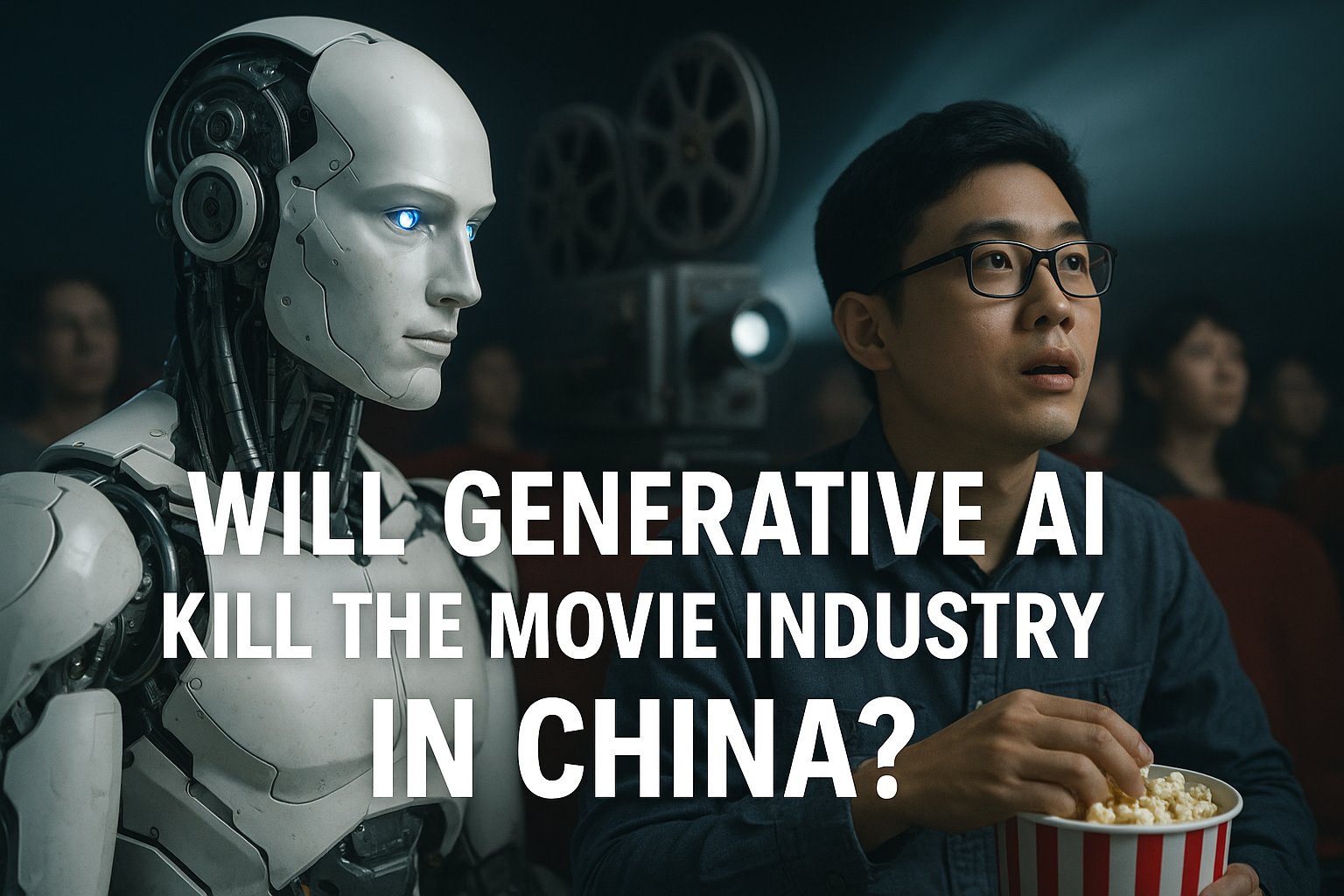
China’s film industry, the world’s second-largest, is under pressure from a sharp box office decline and the rapid rise of generative AI. In 2024, China’s box office revenue fell to 42.5 billion yuan ($5.82 billion), down 22.6% from 2023 and 34% below the pre-pandemic peak in 2019 (Reuters). At the same time, Chinese AI video tools such as Kling, Vidu, and Seedance are making cinema-style video creation faster and cheaper (Radii). This raises a core question: Is AI a threat that will replace human filmmaking, or a tool that will reshape the industry? The thesis of this article is that generative AI will not kill China’s movie industry, but it is already changing how films are made, who gets hired, and what audiences consume.
China’s Film Industry Is Already in Trouble
2024 was a weak year for cinema overall. Only 612 feature films were produced, down from 792 in 2023, and domestic box office fell 27.3% year over year (Reuters). Moviegoing also dropped, with 1.01 billion admissions in 2024 versus 1.299 billion in 2023 (Cinemanext). Audiences are concentrating around holidays and a few standout genres, making the market harder to predict. The rise of microdramas and mobile-first entertainment has intensified competition for attention. The key takeaway is that AI did not create the industry’s weakness; it is accelerating a sector that was already fragile.
What Generative AI Can Do in Chinese Filmmaking
Chinese AI video platforms have advanced rapidly, with Kling, Vidu, and Seedance becoming major players in the space (Radii). Seedance 2.0 can generate video with sound effects and dialogue from text prompts, signaling a major leap in capability (BBC). AI is already being used across parts of the production pipeline, including video generation, voiceovers, music, and sound effects (arXiv). Commercial adoption is no longer theoretical: Base Media used generative AI for a short animation for iQiyi’s Wonderworks (Marketplace/Business News). AI also lowers costs dramatically, with some creators producing stylized trailers for a fraction of traditional production budgets (ThinkChina). The key takeaway is that AI is becoming a practical production tool, not just a novelty.
The Human Cost: Jobs, Wages, and Industry Contraction
Hengdian World Studios, a key hub for China’s film and TV production, has seen major declines in crews and day labor opportunities (YouTube/Industry report). Many actors in mainland China lack stable work, and a significant share earn very low annual incomes (Vision Times). AI-generated short dramas are adding pressure by replacing some live-action production roles entirely (CNN). Real-world examples show how quickly jobs can disappear when productions pivot to AI (Mindsets/Social Media Report). Background actors and lower-tier production workers are especially vulnerable as AI-driven workflows expand. The key takeaway is that the biggest near-term impact of AI is likely job displacement, not the disappearance of cinema itself.
The Microdrama Boom: Where AI Is Spreading Fastest
China’s short-drama market has exploded, with massive volumes of content produced for mobile audiences (NYT). Some estimates suggest the AI microdrama market could be worth more than $3 billion, with production costs as low as $30 per minute (NYT). AI-generated clips are attracting huge view counts, showing that speed and volume can outweigh traditional production values. Chinese rules require labeling AI-generated content, but that has not slowed consumption (NYT). The problem for traditional studios is not just quality; it is the sheer scale of AI content flooding the market. The key takeaway is that microdramas may be the clearest sign that AI is reshaping entertainment economics in China.
Why Human-Made Movies Still Matter
Ne Zha 2 offers a powerful reminder that audiences still reward ambitious human-made storytelling, with major global box office success (Wikipedia) / (Variety). AI still struggles with the qualities that define strong cinema: empathy, taste, emotional truth, humor, and judgment (Substack). Long-form storytelling, character consistency, and nuanced performance remain difficult for AI systems (arXiv). Even in a crowded market, audiences still seek out human-led dramas and premium experiences (CNN). The key takeaway is that AI can imitate style, but it still cannot fully replace the emotional depth of human storytelling.
Regulation, Copyright, and the Legal Race to Catch Up
Chinese courts have ruled that AI-generated images can qualify for copyright protection, giving creators and studios more legal certainty (China IP Law Update). This legal stance may encourage faster adoption of AI-generated content in China. At the same time, global copyright disputes involving AI are increasing across creative industries (MDPI). Hollywood studios have already challenged AI tools over the use of copyrighted characters and likenesses (BBC). China’s policy environment appears relatively supportive of AI development, which may accelerate adoption faster than regulatory guardrails can respond. The key takeaway is that legal clarity is helping AI advance, but copyright conflict remains a major fault line.
What Happens Next? Three Possible Futures
Scenario A: Coexistence
AI handles pre-visualization, VFX, background generation, and microcontent. Human creators focus on high-value theatrical films and premium storytelling. The industry splits into low-cost AI content and high-investment human-made cinema.
Scenario B: Displacement
AI takes a larger share of original content spend and reshapes revenue allocation (McKinsey). Mid-budget productions and many behind-the-scenes roles face the biggest risk. Background actors, post-production teams, and some VFX providers could be hit hardest.
Scenario C: Creative Renaissance
Lower costs make filmmaking more accessible to independent creators. AI helps smaller teams produce and localize content faster. Chinese stories may travel further globally through AI-assisted adaptation and distribution.
Conclusion: Not the End of Movies, But the End of the Old Model
To reframe the question: AI is unlikely to kill China’s movie industry, but it is already ending the old way of making films. What is fading: labor-heavy, expensive, inefficient production models. What is emerging: a hybrid industry where AI handles repetitive tasks and humans focus on originality, emotion, and vision. Ne Zha 2 proves there is still strong demand for human-crafted cinema, while the AI microdrama boom shows the scale of the transformation (Variety) (NYT). The final takeaway is that the Chinese movie industry will survive, but only if it learns how to use AI without losing what makes stories human.
Sources
- arXiv – AI in Film Production
- BBC – Seedance 2.0
- China IP Law Update – Copyright in AI Images
- Cinemanext – China Cinema Sector
- CNN – Short Drama AI China
- Substack – Why Filmmakers Should Pay Attention
- Marketplace/Business News – Base Media AI Animation
- Mindsets/Social Media Report – Chinese Short Dramas AI
- MDPI – Copyright Disputes AI
- McKinsey – AI in Film and TV Production
- NYT – China Microdrama AI Backlash
- Radii – China AI Video Generators Global Soft Power
- Reuters – China 2024 Box Office Plunges
- ThinkChina – AI Video China
- Variety – Ne Zha 2 Box Office
- Vision Times – China Film Industry Slumps
- Wikipedia – Ne Zha 2
- YouTube/Industry report – Hengdian Studios Decline