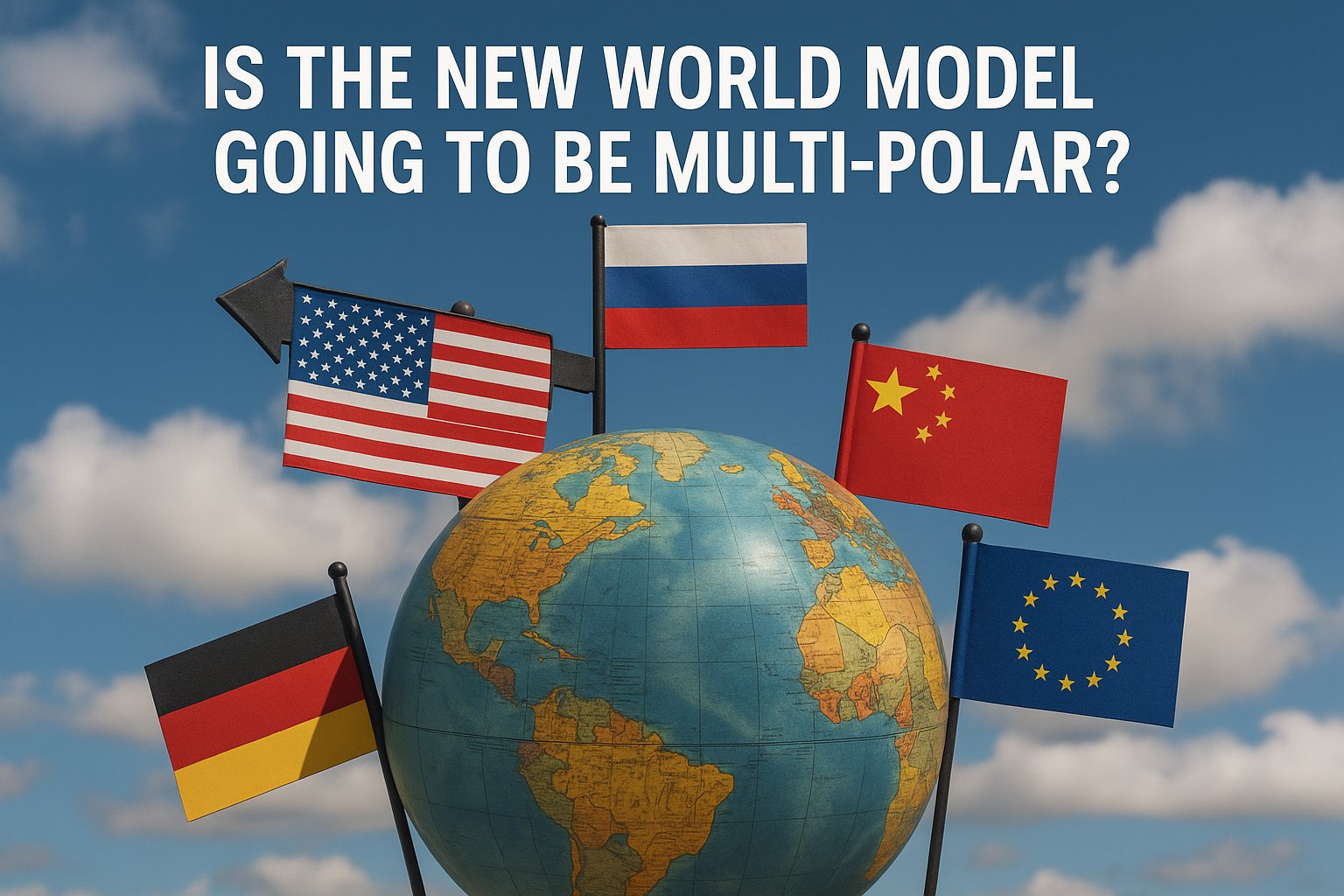
Is the New World Model Going to Be Multi-polar?
I. Introduction: Why the World Order Question Matters Now
The post-Cold War unipolar era is fading, and the global system is becoming more contested and less predictable. The central question is no longer whether the United States remains the sole superpower, but whether the world is truly becoming multipolar—or simply more fragmented, uneven, and unstable. This article argues that the emerging order is not just multipolar, but multi-layered, with different power structures in military, economic, and transnational domains (Washington Institute) (Belfer Center).
II. What Does “Multipolar” Actually Mean?
In international relations, polarity describes how power is distributed. Unipolar systems have one dominant power (like the U.S. after 1991); bipolar systems have two (Cold War U.S. and USSR); multipolar systems have several major powers (Wikipedia — Polarity in International Relations). Historical multipolarity, such as the 19th-century Concert of Europe, was a managed balance among great powers. Today’s version is far more complex: power is spread across states, middle powers, institutions, and non-state actors. Joseph Nye’s “three-dimensional chess” framework captures this: military power is unipolar, economic power is multipolar, and transnational issues (climate, pandemics, cyber) are widely dispersed (Belfer Center — The Future of Power).
III. The End of the Unipolar Moment: What Changed?
The United States remains the strongest single power, but it no longer operates as the world’s only superpower (Washington Institute). China’s rise is the most important structural shift—its economic reach and strategic leverage have grown enormously (Tandfonline — US-China Great Power Rivalry) (YouTube — Is China on track to become the world’s next superpower?). Meanwhile, Russia acts as a revisionist power, seeking to disrupt Western-led norms and accelerate order fragmentation (SWP Berlin — Multipolarities). The world is in a transitional “purgatory of polarity,” not a settled new order (Munich Security Report 2025).
IV. BRICS and the Search for an Alternative Power Center
BRICS has evolved from an acronym into a 10-member grouping with broader geopolitical ambitions (Carnegie Endowment — BRICS Expansion). It reflects dissatisfaction with Western-dominated institutions and a desire for more representative global governance (Clingendael — BRICS and Multipolarity). The bloc’s trade and economic significance is growing, as shown by its 2025 summit and Rio Declaration (China Diplomacy — BRICS Growth) (Al Habtoor Research — BRICS Summit 2025). However, internal divisions, differing interests, and limited coordination capacity temper this optimism (Atlantic Council — BRICS Building Multipolar World).
V. Middle Powers: The Most Important Swing Players
The focus must shift from great powers to middle powers such as India, Indonesia, Brazil, Turkey, South Africa, and Nigeria (Policy Center — 2025: Year of the Middle Powers). These states matter because they can bridge rival blocs, shape issue-specific coalitions, and influence outcomes without dominating the system (Harvard Kennedy School — Middle Powers Will Make a Multipolar World). Indonesia, for example, exemplifies strategic nonalignment and regional influence in a contested Indo-Pacific environment (Shaping Tomorrow — Shifting Global Power). Multipolarity is not only about rivalry among giants; it is also about the growing agency of states that can tilt the balance on key issues.
VI. The Financial Dimension: De-dollarization and Economic Multipolarity
De-dollarization is one of the clearest signs of economic diversification (Wikipedia — Dedollarisation). Central banks are increasing gold reserves and diversifying away from dollar dependence (J.P. Morgan — De-dollarization). The main drivers include sanctions risk, fiscal concerns, and the desire for monetary autonomy (AnalystPrep — De-Dollarization). Yet the dollar still dominates core parts of global finance, so de-dollarization remains a trend, not a completed shift (CFR — Jane Fraser on De-dollarization).
VII. Why Multipolarity Can Also Mean More Fragmentation
The central paradox is that more centers of power do not automatically produce stability (Munich Security Report 2025). Current conflicts, including Ukraine and Gaza, are both symptoms and accelerants of a more fractured international order (Credendo — A New Multipolar Order). Without a dominant arbiter, competition becomes less manageable and more unpredictable (CIGI — Transforming the UN for a Multipolar World). An emerging “West vs. the Rest” dynamic further deepens the geopolitical split (GIS Reports — Prospects for a Multipolar World Order).
VIII. Can Global Institutions Adapt?
Institutions such as the UN Security Council, IMF, and World Bank no longer fully reflect current power realities (GCSP — Meaningful UNSC Reform). The UN Pact for the Future calls for more representative and accountable governance (UN — Pact for the Future). Meanwhile, parallel institutions like the BRICS New Development Bank and AIIB signal that reform is not waiting for consensus (CIGI — Transforming the UN for a Multipolar World). Institutional survival will depend on whether reform can keep pace with geopolitical change.
IX. Competing Visions of the New Order
Different actors interpret multipolarity in very different ways (SWP Berlin — Multipolarities). China sees multipolarity as a way to weaken Western dominance. Turkey views it as a strategic reality that expands room for maneuver. Indonesia worries about conflict and instability in a power-transition world. India pursues strategic autonomy through balancing multiple partnerships. The United States resists decline, even as its relative position becomes more regionalized (CIGI — Transforming the UN for a Multipolar World). Multipolarity is not one project, but a contested concept with competing political meanings.
X. Is the World Really Multipolar, or Something Else?
Some argue that the world is better described as “bi-multipolar,” with the U.S. and China at the top and middle powers operating in between (Foreign Affairs — The Multipolar Mirage). An alternative vision is a “Concert of Powers,” a managed form of great-power cooperation (Foreign Affairs — The New Concert of Powers). The reality is likely hybrid: military power remains heavily U.S.-centric, economic power is more dispersed, and transnational challenges are shared but poorly governed.
XI. Conclusion: The New World Model Is Multi-layered, Not Just Multi-polar
The world is indeed moving beyond unipolarity, but the new system is uneven, contested, and domain-specific. Military power remains concentrated, economic power is increasingly distributed, middle powers matter more than before, and global institutions are under strain. Three futures loom: Managed Multipolarity — cooperation through reformed institutions; Fragmented Rivalry — sharper blocs, sanctions, and proxy conflicts; and Multi-order Chaos — different rules across regions and issue areas. How the world adapts to this transition will shape the 21st century.
Sources
- Al Habtoor Research – BRICS Summit 2025
- AnalystPrep – De-Dollarization
- Atlantic Council – BRICS Building Multipolar World
- Belfer Center – The Future of Power
- Carnegie Endowment – BRICS Expansion
- CFR – Jane Fraser on De-dollarization
- China Diplomacy – BRICS Growth
- CIGI – Transforming the UN for a Multipolar World
- Clingendael – BRICS and Multipolarity
- Credendo – A New Multipolar Order
- Foreign Affairs – The New Concert of Powers
- Foreign Affairs – The Multipolar Mirage
- GCSP – Meaningful UNSC Reform
- GIS Reports – Prospects for a Multipolar World Order
- Harvard Kennedy School – Middle Powers Will Make a Multipolar World
- J.P. Morgan – De-dollarization
- Munich Security Report 2025
- Policy Center – 2025: Year of the Middle Powers
- Shaping Tomorrow – Shifting Global Power
- SWP Berlin – Multipolarities
- Tandfonline – US-China Great Power Rivalry
- UN – Pact for the Future
- Washington Institute – Why the US Is No Longer the World’s Only Superpower
- Wikipedia – Dedollarisation
- Wikipedia – Polarity in International Relations
- YouTube – Is China on track to become the world’s next superpower?