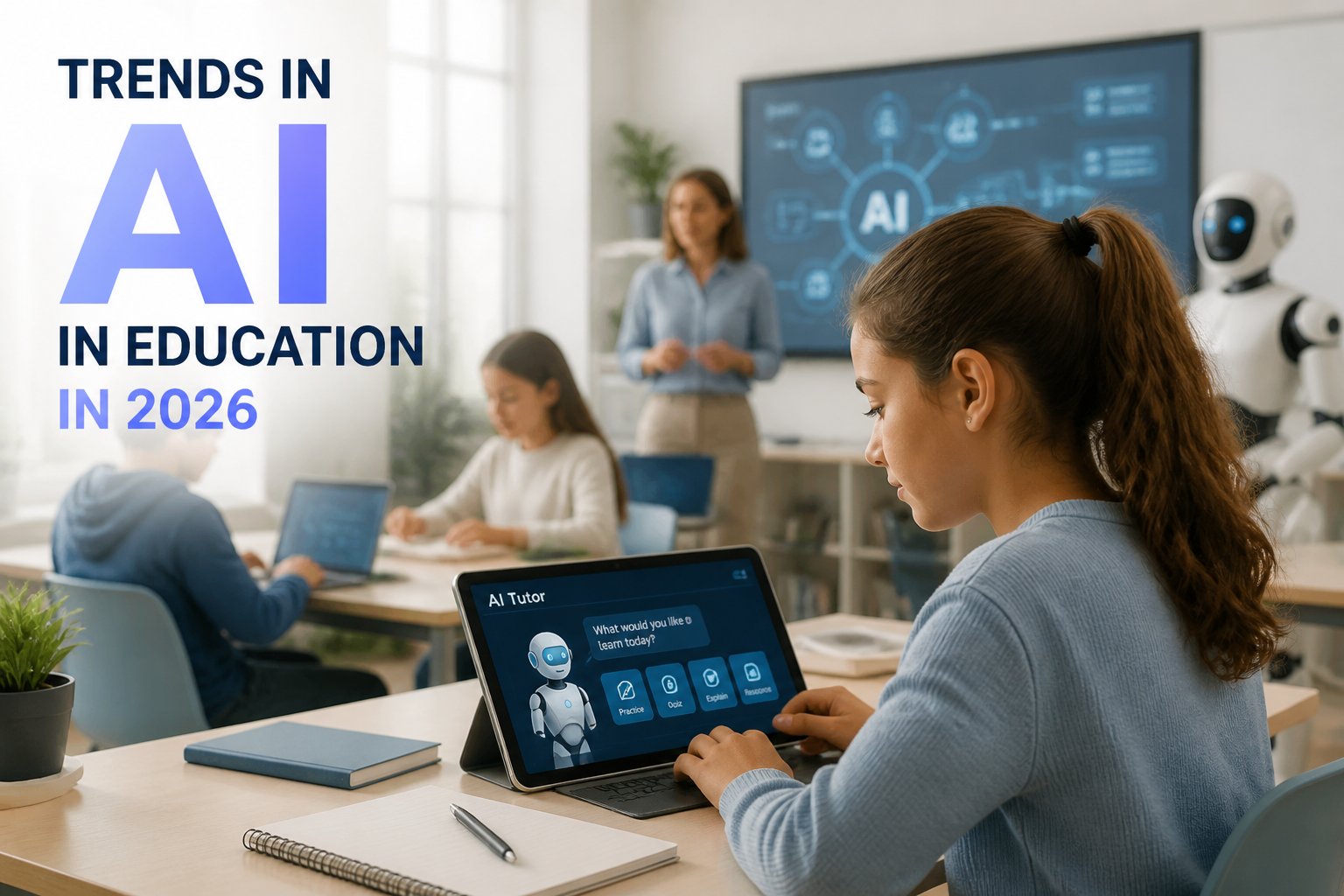
Trends in AI in Education in 2026
The AI-Powered Classroom of 2026: 10 Trends Reshaping Education as We Know It
1. Introduction: Why 2026 Is a Turning Point for AI in Education
Just a few years ago, artificial intelligence in education was largely experimental—a pilot program here, a chatbot tutor there, a cautious toe dipped into unfamiliar waters. But 2026 marks a decisive shift. AI has moved from the periphery to the center of the classroom experience, quietly transforming how students learn, how teachers teach, and how entire institutions operate. The pace of adoption has accelerated dramatically across K–12 schools, higher education institutions, and workforce training programs alike. What was once novel has become normalized.
This year, however, represents more than just wider adoption. 2026 signals a maturation of the conversation around AI in education. We are no longer asking *whether* to use AI, but *how* to use it responsibly. The focus has shifted from mere experimentation to embedding artificial intelligence into the fabric of education with intention, care, and a clear-eyed understanding of both its promise and its pitfalls. Literacy, equity, assessment integrity, and student engagement have emerged as the central pillars of this new era.
In the pages that follow, we will explore ten major trends reshaping education in 2026. These are not speculative predictions from a distant future. They are developments unfolding right now in classrooms, faculty meetings, policy offices, and learning management systems around the world. For students, educators, and institutional leaders, understanding these trends is no longer optional—it is essential.
2. AI Literacy Becomes a Core Educational Skill
In 2026, knowing how to use generative AI is no longer a niche technical skill. It has become a fundamental competency, as essential as reading, writing, and mathematics. Governments and educational bodies worldwide are beginning to mandate AI education, embedding it into national curricula and issuing formal guidance on responsible use.
This shift reflects a simple reality: students are already using AI tools in vast numbers, often without any formal training in how to use them safely, ethically, or effectively. A student who asks ChatGPT to write their essay is using AI, but so is the student who uses it to brainstorm ideas, refine their arguments, or check for logical gaps. The difference lies in understanding what they are doing and why.
Core AI literacy in 2026 encompasses several interconnected skills. Students must understand fundamental AI concepts—how models are trained, what biases they carry, and where their limitations lie. They must learn to create with AI, using it as a collaborative partner rather than a crutch. They need to interact effectively with AI agents, crafting prompts that yield useful and accurate outputs. Most importantly, they must develop the critical capacity to evaluate AI-generated content, distinguishing between reliable information and hallucinated nonsense. And woven through all of this is ethical judgment: knowing when AI use is appropriate, when it undermines learning, and how to credit AI assistance transparently.
The classrooms that succeed in 2026 will treat AI literacy not as a one-time workshop but as an ongoing, integrated part of the curriculum. It will appear in science classes discussing algorithmic bias, in English classes evaluating AI-generated text, and in history classes examining the societal implications of automation. AI literacy is no longer an add-on. It is foundational.
3. Hyper-Personalized Learning Moves Into the Mainstream
For decades, educators have dreamed of personalized learning—instruction tailored to each student’s unique needs, pace, and preferred style. In 2026, that dream is becoming a practical reality at scale. AI-powered adaptive learning tools have moved from niche applications to standard equipment in classrooms and on digital learning platforms.
The transformation is visible in real time. Intelligent tutoring systems now identify learning gaps the moment they emerge, adjusting instruction dynamically to address misunderstandings before they solidify. A student struggling with quadratic equations receives additional practice problems and alternative explanations. A student who has already mastered the concept moves on to enrichment material. The system does not wait for a test to reveal what went wrong. It intervenes immediately.
Generative AI has supercharged this personalization. Adaptive platforms can now create custom reading passages, generate practice problems tailored to a student’s interests, and produce assessment items that target specific skills. Content is no longer static; it is generated on demand, shaped by each learner’s progress and needs. Predictive analytics anticipate future challenges, allowing teachers to intervene proactively rather than reactively.
The result is a fundamental shift away from one-size-fits-all instruction. In 2026, the most effective classrooms are those that use AI to differentiate instruction at a level of granularity that was previously impossible. This does not mean teachers become obsolete. On the contrary, they become more important than ever—not as deliverers of generic content, but as facilitators, mentors, and guides who use AI-generated insights to reach every student where they are.
4. Agentic AI Starts to Reshape Teaching and Administration
The AI tools of yesterday were reactive: they answered questions, generated text, or performed simple tasks when prompted. In 2026, we are witnessing the rise of agentic AI—systems that can act autonomously, completing complex tasks on behalf of users without constant supervision. And education is beginning to feel the impact.
These agentic systems are finding their way into diverse educational roles. They serve as tutoring assistants that monitor student progress and provide targeted support without waiting for a teacher to notice a problem. They handle administrative workflows—scheduling, grading, reporting—freeing educators from the drudgery that consumes so much of their time. They support curriculum development by generating lesson plans aligned to standards and suggesting accommodations for diverse learners.
Higher education institutions, in particular, are beginning to experiment with what some are calling “AI colleagues.” These are not replacements for faculty and staff but digital teammates that handle routine tasks, answer common student questions, and provide preliminary feedback on assignments. The goal is not to reduce human presence but to amplify it, allowing educators to focus on the high-value work that only humans can do: mentoring, building relationships, inspiring curiosity.
Of course, this trend raises significant questions. Who is accountable when an AI system makes a mistake? How much autonomy should we grant these tools? What happens to institutional knowledge and human judgment when we outsource important decisions to algorithms? These are not rhetorical questions. In 2026, educators and administrators are grappling with them in real time, working to establish boundaries and oversight structures that allow innovation without abandoning responsibility.
5. Assessment Is Being Redesigned for the AI Era
Generative AI has thrown traditional assessment into crisis. When a student can produce a polished essay, solve a complex problem, or generate a detailed analysis with a single prompt, what exactly are we measuring when we assign those tasks? The answer, increasingly, is that we are measuring something very different from what we intended.
In response, 2026 is witnessing a fundamental redesign of assessment practices. The traditional product-based assignment—the final essay, the take-home test, the end-of-unit project—is being supplemented, and in some cases replaced, by process-based assessment. Educators are shifting focus from what students produce to how they produce it.
This takes many forms. Students might be asked to document their process, showing how they used AI tools and why. They might complete assignments in stages, with feedback and reflection built into each step. They might engage in authentic, discipline-specific problem solving that cannot easily be automated. Some assessments now occur in controlled environments where AI use is restricted. Others explicitly invite AI collaboration, asking students to evaluate and refine AI-generated outputs rather than create from scratch.
Institutions are also becoming clearer about their expectations. Many have developed guidelines specifying which assessments permit AI use and which require independent student work. The goal is not to ban AI—that ship has sailed—but to design assessments that measure genuine understanding, critical thinking, and skill development. This is hard work, and it is far from complete. But 2026 represents a turning point in which educators are no longer pretending that business as usual is an option.
6. Academic Integrity Shifts From Detection to Design
The academic integrity landscape has transformed dramatically. Student use of generative AI for coursework is now widespread, and the detection arms race has largely failed. AI detection tools remain unreliable, producing false positives, false negatives, and inconsistent results that erode trust between students and institutions. The strategy of catching and punishing unauthorized AI use is proving unsustainable.
As a result, 2026 has seen a fundamental shift in approach. The focus is moving from detection to design. Instead of asking “How do we catch students using AI?” forward-thinking institutions are asking “How do we design learning experiences that make unauthorized AI use unnecessary or undesirable?”
This change is reshaping policies, pedagogy, and practice. Schools are updating academic integrity policies to address AI use transparently, distinguishing between acceptable and unacceptable uses. They are teaching students how to cite AI contributions appropriately, just as they teach citation of human sources. They are redesigning assignments to emphasize process, reflection, and authentic tasks that resist easy automation.
Most importantly, educators are having honest conversations with students about the purpose of assessment and the value of learning. When students understand that the goal is not merely to produce correct answers but to develop skills and knowledge that will serve them in the future, they are more likely to engage meaningfully with the work. Academic integrity in 2026 is increasingly about transparency, guidance, and thoughtful design rather than surveillance and punishment. It is a more humane and arguably more effective approach.
7. Teachers Need More AI Training and Professional Development
Teachers are on the front lines of AI integration, and in 2026, many are feeling the pressure. While some educators have enthusiastically embraced AI tools, many others are using them without formal training, and still others remain hesitant or uncertain. The gap between AI adoption and AI preparedness is a growing concern.
The data is clear: effective AI implementation requires strong teacher support. Schools that invest in professional development around AI see better outcomes, more equitable use, and fewer problems with misuse or misunderstanding. Yet formal training remains inconsistent, often left to individual teachers to pursue on their own time.
The most successful implementations in 2026 pair AI tools with dedicated professional learning. Teachers are learning how to use AI to save time on lesson planning, differentiation, and resource creation. They are exploring how AI can help them provide more personalized feedback to students. They are developing their own AI literacy so they can model responsible use in their classrooms.
Crucially, these professional development efforts are not about replacing teachers with technology. They are about empowering teachers with better tools and deeper understanding. The message is consistent: AI is not a substitute for teacher expertise. It is a complement that, when used well, can make expert teachers even more effective. The institutions that invest in their teachers are the ones seeing the most transformative results.
8. The AI Access Divide Becomes a Major Equity Issue
There was a time when the digital divide in education was primarily about access to devices and internet connectivity. In 2026, that divide has shifted. While disparities in basic access persist, the new frontier of inequity is about the quality of AI implementation.
Equal access to AI tools does not automatically produce equal outcomes. Students with stronger support systems at home, better AI literacy training at school, and clearer guidance from teachers gain far more from the technology than those without these advantages. A student who learns to use AI as a collaborative thinking partner will outperform a student who uses it simply to get answers. A school that integrates AI thoughtfully into its curriculum will produce more capable graduates than one that provides tools without instruction.
Accessibility is also emerging as a critical concern. As schools adopt AI tools, they must ensure those tools are usable by students with disabilities. This requires careful evaluation of AI products for compliance with accessibility standards and a commitment to inclusive design.
The new digital divide, in short, is about implementation quality. It is about who gets guidance and who gets left to figure things out alone. It is about which schools have the resources to train teachers and which ones hand out AI accounts without support. Addressing this divide requires intentional investment in professional development, infrastructure, and support systems that ensure all students—not just the most advantaged—can benefit from the AI transformation.
9. Policy and Governance Are Catching Up With AI Adoption
For several years, AI adoption in education outpaced policy development. Schools and teachers were experimenting with tools while administrators and policymakers scrambled to catch up. In 2026, that gap is finally beginning to close.
State and national policymakers are moving quickly to regulate AI use in education. New laws and guidelines address data privacy, algorithmic transparency, accessibility requirements, and acceptable classroom practices. Schools are being asked—and in some cases required—to develop clear, written policies on AI use that cover everything from student assignments to teacher tools to vendor procurement.
Model policies are emerging at the state level, providing frameworks that individual institutions can adapt to their contexts. These policies typically address when and how AI can be used in assessments, what data privacy protections must be in place, how AI tools should be evaluated for bias, and what training is required for educators and students.
Governance is becoming essential for another reason: trust. When schools have clear, transparent policies, students and parents are more likely to trust that AI is being used responsibly. When policies are absent or vague, suspicion and confusion flourish. The institutions that succeed in 2026 are those that treat AI governance not as a bureaucratic burden but as a foundation for responsible innovation.
10. Student Engagement and Well-Being Remain Central
Amid all the technological transformation, one truth remains constant: education is fundamentally a human endeavor. In 2026, the most forward-thinking institutions are using AI not to replace human connection but to protect and enhance it.
The logic is straightforward. When AI handles routine tasks—grading, scheduling, data entry, basic tutoring—teachers have more time for the work that matters most: building relationships, offering encouragement, understanding individual students, and creating the conditions for genuine engagement. AI is being used to reduce administrative burden precisely so that educators can focus on meaningful human interaction.
This emphasis on engagement is not sentimental. It is evidence-based. Research consistently shows that student engagement—the sense of belonging, motivation, and connection to learning—is one of the strongest predictors of academic success. Engagement is now being recognized as a key indicator of whether technology is actually improving learning outcomes. If AI adoption leads to disengagement, isolation, or passive consumption, it is failing its purpose.
The challenge for 2026 is balancing efficiency with humanity. AI can make education more efficient, but efficiency is not the goal. The goal is education that is effective, meaningful, and supportive of student well-being. The institutions that keep this balance in view are the ones that will thrive.
11. AI Is Redefining Workforce Learning and Lifelong Education
The impact of AI on education extends far beyond traditional classrooms. In 2026, the world of work is changing rapidly, and education systems are responding by placing greater emphasis on adaptability, transferable skills, and the ability to “learn how to learn.”
AI is reshaping credentialing, workforce training, and higher education pathways. Microcredentials, digital badges, and competency-based credentials are gaining traction, often powered by AI systems that assess skills directly rather than through proxy measures like course completion. Employers are increasingly interested in what candidates can do, not just what degrees they hold.
Partnerships between education providers and technology companies are expanding rapidly. These collaborations are producing governed, embedded AI learning tools that workers can access on the job. The line between formal education and workplace learning is blurring as AI makes just-in-time, personalized professional development more feasible.
Lifelong learning is no longer an aspiration. It is an economic necessity. As AI automates routine tasks and transforms job requirements across industries, workers must continuously update their skills. Education systems in 2026 are beginning to embrace this reality, designing programs that support learning across the lifespan rather than concentrating it in the early years of life.
12. Conclusion: What These Trends Mean for the Future of Education
As we look across these ten trends, three key takeaways emerge.
First, 2026 is the year AI becomes deeply embedded in education—not merely piloted in isolated classrooms or deployed in experimental programs, but integrated into the daily operation of schools, universities, and training programs. The conversation has moved from “should we use AI?” to “how do we use it well?”
Second, the biggest wins will come from responsible adoption, not rapid adoption alone. The institutions that succeed are not those that rush to implement the latest tools without thought. They are those that invest in training, policy, equity, and thoughtful design. They recognize that technology is only as good as the systems and people surrounding it.
Third, the future of AI in education depends on balancing innovation with equity, engagement, ethics, and human connection. AI can enhance learning in powerful ways, but it cannot replace the relationships, curiosity, and community that make education transformative. The most successful classrooms of 2026 are those that use AI to amplify human potential, not diminish it.
The institutions that thrive in this new era will be those that keep people at the center. They will use AI to reduce barriers, deepen understanding, and free educators to do what they do best. They will approach technology with both excitement and caution, embracing its possibilities while remaining clear-eyed about its limitations. And they will remember, always, that education is ultimately about human flourishing—a goal that no algorithm can achieve alone.
The classroom of 2026 looks different from the classroom of 2020. But the core purpose remains the same: to help every learner realize their full potential. AI is a powerful tool for that mission. It is not the mission itself.